The AI-App SLA: A Four-Layer Framework for Agency Support Tiers (2026)
The classic uptime-plus-response SLA quietly broke for AI builds. Here is a four-layer AI-app SLA (availability, response, AI behavior, continuity) mapped to a three-tier agency support ladder, with the token-cost and model-deprecation clauses most retainers forget.
On this page
Quick Answer
An AI-app SLA is the service-level agreement an agency hands a client after shipping an application built on an AI app builder. As of 2026, the classic uptime-plus-response-time template is no longer enough, because an AI app also leans on third-party model APIs, token budgets, and model versions that get deprecated on someone else's schedule. This framework splits the agreement into four layers (availability, response and resolution, AI behavior, and change and continuity) and maps them to a three-tier support ladder (Essential, Managed, Partner). The point is simple: price recurring work against named risks, not against a gut feeling.
Most agency retainers still describe an app as if it were a static WordPress site with a database. AI builds broke that model quietly. The moment your build calls a hosted model, streams tokens, or ships an agent, you have inherited a dependency you do not control and a failure mode your old SLA never named. This is the framework we use to write agreements that survive contact with a real production incident.
Why the old SLA template quietly broke
A traditional software SLA answers three questions: is it up, how fast do you respond, and how fast do you restore. Those questions still matter. They are just no longer sufficient.
Consider a single client app that summarizes support tickets with a hosted language model. Nothing in the codebase changed overnight, yet on Tuesday the summaries came back truncated. The cause was upstream: the model provider rotated a default version and the new one returned a different token limit. Your uptime monitor stayed green the entire time. Your response-time clause never triggered, because the site was technically up. The client, reasonably, still felt the product was broken.
That gap is the whole problem. An AI feature can degrade without the app going down, without any code shipping, and without a single alert firing. If your SLA only measures availability, you have written an agreement that cannot see the most common way modern builds fail.
The four-layer AI-app SLA
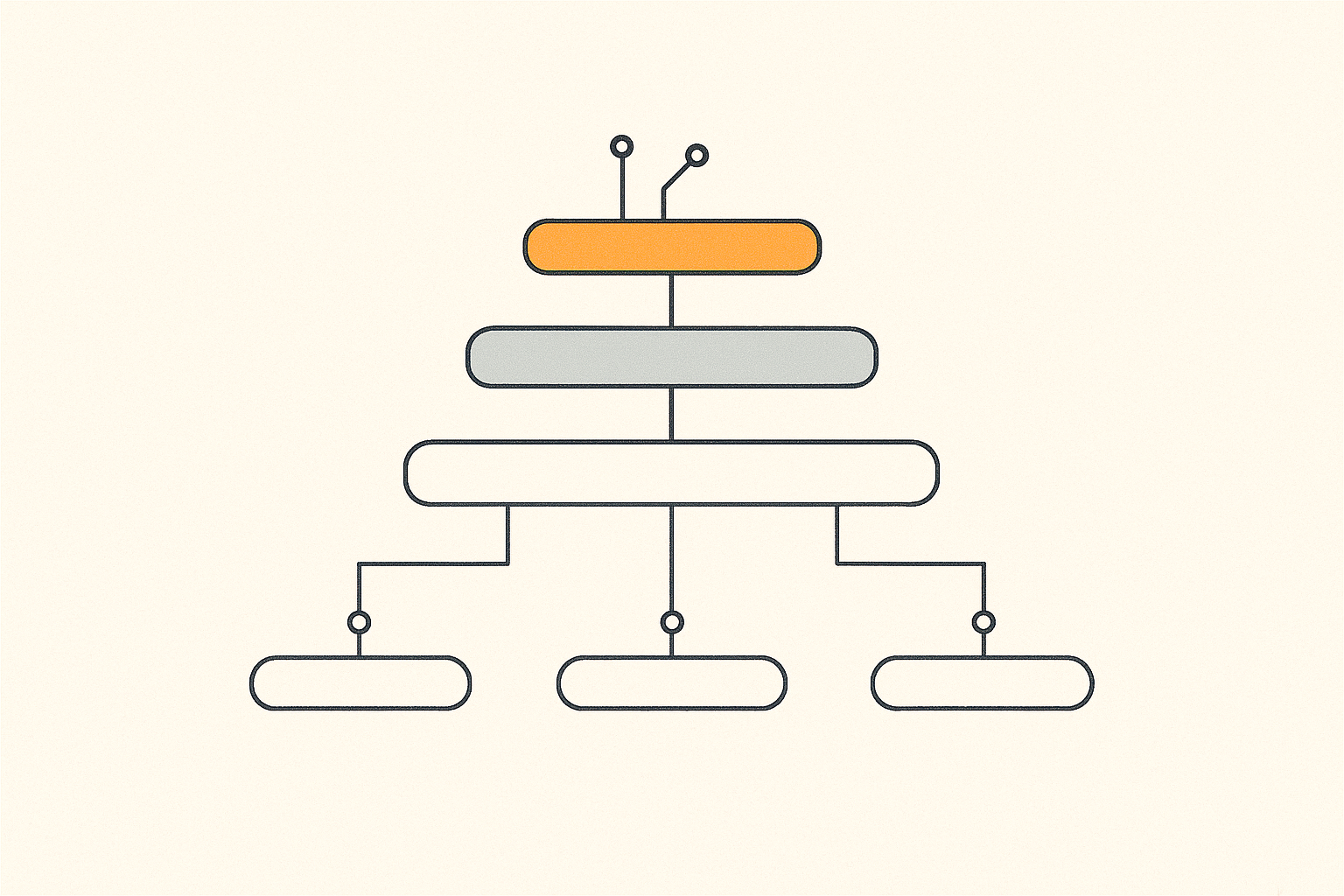
Treat the agreement as four stacked layers. Each layer names a distinct failure surface, and each maps to a measurable commitment. The novelty is layer three; the other three are the mature service-management basics adapted to AI builds. For the classic layers, a solid public reference on how to structure availability and severity commitments is the Atlassian ITSM guide to SLAs (2026).
Scroll to see more
| Layer | What it governs | Example commitment | Who it protects |
|---|---|---|---|
| 1. Availability | Is the app reachable | 99.5% monthly, measured on shared-dependency uptime | Client trust |
| 2. Response and resolution | How fast you react and restore | P1 respond 1h, restore 8h; P4 respond 2 business days | Both sides |
| 3. AI behavior | Does the AI feature still do its job | Model-deprecation notice within 5 business days; output-schema regression treated as P2 | The part nobody else names |
| 4. Change and continuity | Ownership, migration, exit | Source handed over, documented deprecation path, 30-day offboarding | Client and your reputation |
A word on layer one. Because the app depends on the builder's hosting and on third-party model APIs, your real availability is the product of dependencies you partly do not own. Write the clause as shared-dependency uptime and exclude documented upstream provider outages, the same way infrastructure vendors exclude force majeure. Promising 99.9% on a stack whose model provider only offers 99.5% is a clause you cannot honor.
Layer three, the part worth getting right
The AI-behavior layer is where agencies either look like professionals or get blindsided. Break it into four named commitments.
Model deprecation. Hosted model versions retire on a published cadence. Your SLA should state that you monitor the provider's deprecation notices and that, once a notice affects a client feature, you migrate within the tier's window. Without this clause, a provider's routine version sunset becomes an emergency the client blames on you.
Output-quality regression. Define what "the AI feature is broken" actually means before you are arguing about it at 11pm. Split it in two. Structural regression, where the output stops matching the expected schema or format, is objective and belongs at P2. Subjective quality, where answers feel worse, is real but must be tied to a reproducible evaluation set, not to vibes. Ship every AI feature with a small saved eval so "worse" has a number attached.
Latency and cost drift. Token cost and latency are variable inputs, not fixed ones. Set a monthly token-budget threshold with an alert, and state in writing who absorbs overage when usage spikes. An agency that eats unbounded token cost on a fixed retainer is running an uninsured position.
Safety and abuse. Name who handles prompt-injection reports, moderation gaps, and abusive inputs, and at what severity. For most business apps this is a P2 with a defined containment step, not a silent gap.
The three support tiers
Layers describe what you promise. Tiers describe how much of it the client is paying for. Map the four layers onto a three-step ladder and attach each tier to a retainer band. This keeps pricing honest, because the client is buying a named response window, not a vague sense of being looked after.
Scroll to see more
| Tier | Best for | Response and AI-behavior windows | Continuity |
|---|---|---|---|
| Essential | Stable, low-traffic internal apps | P1 next business day; deprecation migration within 30 days | Source delivered, self-serve docs |
| Managed | Revenue-touching client apps | P1 respond 4h, restore same day; deprecation within 10 business days; eval-checked monthly | Quarterly continuity review |
| Partner | Mission-critical or regulated apps | P1 respond 1h, restore 8h; deprecation within 5 business days; weekly eval + cost report | Named engineer, documented exit runbook |
The ladder does double duty. It gives the client a clear upgrade path when their app matures, and it gives you a defensible reason to charge more than a flat "maintenance" line item. This is the same logic behind a productized maintenance retainer, applied to service levels instead of scope.
A worked example
A boutique agency ships a client-facing quoting tool with an AI drafting feature. They put it on the Managed tier at a monthly retainer. Two months in, the model provider announces a version deprecation. Because the SLA named a 10-business-day migration window, the agency schedules the swap calmly, runs the saved eval to confirm the drafts still match the required format, and sends a one-line change note. No fire drill, no awkward invoice, no eroded trust.
Six months later the client's volume triples and token cost drifts past the alert threshold. The overage clause already said the client covers usage above the named budget, so the conversation is a routine tier upgrade to Partner, not a dispute. The SLA did what a good SLA does: it turned two predictable surprises into scheduled, priced work.
How the build platform shapes your continuity clause
Layer four depends heavily on what your build platform actually hands you. If you cannot deliver the source, your continuity clause is fiction. Builders differ sharply here as of 2026, so evaluate this before you sign an SLA, not after.
Scroll to see more
| Platform | Continuity-relevant fact (2026) |
|---|---|
 Totalum Totalum | Lets you "view, edit, and download the complete source code at any time" and states "the code is 100% yours, no vendor lock-in" (Totalum, 2026); data stored in the EU with hourly backups |
 Lovable Lovable | Supabase-backed builds with code export; verify current export and data-residency terms on the Lovable site (2026) |
 Bolt.new Bolt.new | StackBlitz in-browser builds; confirm current export and hosting terms on the Bolt site (2026) |
The practical rule: a platform that gives you the full source, like an AI app builder that hands over a downloadable Next.js project, lets you write a genuine exit runbook in layer four. A platform that keeps you inside its runtime forces a weaker continuity clause, which you must disclose to the client rather than paper over. This is the same ownership question that drives how you write change orders on fixed-price AI builds.
The action checklist
- Rewrite layer one as shared-dependency uptime and exclude documented upstream provider outages.
- Add the four layer-three clauses: deprecation notice window, structural-regression severity, token-budget threshold, and abuse handling.
- Ship every AI feature with a small saved eval so "the quality dropped" has a number.
- Put an overage clause in writing so token spikes are a tier conversation, not a dispute.
- Match each client to a tier, and review the match quarterly as their app matures.
- Confirm your build platform can actually deliver source before you promise a continuity clause.
If you take one thing from this: an AI-app SLA is not an uptime promise with an AI paragraph bolted on. It is a four-layer risk map, and the layer that pays for itself is the one that names how the AI feature can quietly stop doing its job.
Written by
Helena MarshHelena Marsh writes on agency operations, packaging, and delivery economics for DevShopVault. She focuses on the frameworks that turn ad-hoc client work into priced, repeatable services.
Frequently asked questions
What is an AI-app SLA?
It is the service-level agreement an agency gives a client after shipping an app built on an AI app builder. Unlike a traditional SLA, it covers not only availability and response time but also AI-specific failure modes such as model deprecation, output-quality regression, and token-cost drift.
Why is a normal software SLA not enough for an AI app?
A normal SLA only measures whether the app is up and how fast you respond. An AI feature can degrade without the app going down, without any code shipping, and without an alert firing, for example when a model provider rotates a default version. The AI-behavior layer exists to name that failure surface.
What are the four layers of the framework?
Availability (is the app reachable, measured as shared-dependency uptime), response and resolution (how fast you react and restore by severity), AI behavior (model deprecation, output regression, cost and latency drift, abuse handling), and change and continuity (source ownership, migration path, and exit).
How do the three support tiers map to pricing?
Essential suits stable internal apps with next-business-day response and a 30-day deprecation window. Managed suits revenue-touching apps with faster windows and monthly eval checks. Partner suits mission-critical or regulated apps with the tightest windows, a named engineer, and a documented exit runbook. Each tier attaches to a retainer band so pricing tracks named risk.
How should the SLA handle rising AI token costs?
Set a monthly token-budget threshold with an alert and state in writing who absorbs overage above it. That turns a usage spike into a routine tier-upgrade conversation instead of a billing dispute, and it stops the agency from carrying unbounded, uninsured cost on a fixed retainer.
Related entries
How to Price a White-Label AI App Maintenance Retainer (2026 Agency Framework)
Most agencies price the build and give away the maintenance. Here is a 2026 framework for structuring a white-label AI app maintenance retainer that protects margin: four models, the percent-of-build math, and SLA tiers.
Change Orders on Fixed-Price AI App Builds: A 2026 Decision Matrix for Agencies
AI app builders collapsed the cost of UI re-work but not structural work. Here is the two-band decision matrix agencies should use to decide when to absorb a change, charge a small fee, or write a real change order.
Statement of Work Template for AI App Builds (2026)
A generic SOW template leaks on an AI app build. Here is a copy-paste statement of work plus the four AI-specific clauses a classic template skips.