Change Orders on Fixed-Price AI App Builds: A 2026 Decision Matrix for Agencies
AI app builders collapsed the cost of UI re-work but not structural work. Here is the two-band decision matrix agencies should use to decide when to absorb a change, charge a small fee, or write a real change order.
Updated on July 28, 2026

On this page
Quick Answer (2026): On a fixed-price app build, sort every incoming change into one of two bands. UI-level changes (copy, layout, adding a field to an existing view, a new filter or read-only screen) now cost an hour or two of re-work, because modern AI app builders emit owned, regenerable code. Default to absorbing those or charging a small change order. Changes that touch the data model, a third-party integration, or the authentication and permissions layer are not compressed by the builder, so they stay real change orders: quoted and approved in writing before any work starts. The old "lock the scope and refuse everything" defense was priced for an era when all re-work was expensive. It is not anymore, and clinging to it now quietly costs agencies their retainers.
The fixed-price defense was built for a world where re-work was expensive
Every agency that has run a fixed-price build knows the standard advice. Write a tight scope document, define acceptance criteria, and route every request through a documented change-order process. The industry canon behind that advice, from PMI's guidance on controlling scope creep down to the average agency playbook, all shares one buried assumption: that any change costs real engineering hours, so the agency must defend the baseline or bleed margin.
That assumption held when the whole app was hand-built. Moving a form, adding a column, or splitting one user role into two meant a developer opening the codebase, wiring the change through several layers, and re-testing. Six to ten hours was normal. At a blended rate (we use $120 an hour as the working figure throughout, and explain how to set your own in our AI app build rate card), that is a $720 to $1,200 change order for what the client experiences as a five-minute request. So the client resents the invoice, the agency resents the negotiation, and the "process" becomes a source of friction rather than protection.
In 2026 the cost floor moved. AI app builders that produce owned, editable application code, so you regenerate a component and redeploy instead of hand-threading a change, have collapsed the cost of one whole category of re-work. That does not make change orders obsolete. It makes them selective. The agencies protecting margin now are the ones who stopped charging like every change still costs eight hours, and started charging based on which band the change actually lands in.
The two-band model
Not all re-work got cheap. Only one band did.
The compressed band. Presentation and simple data-entry changes: copy edits, layout and styling, adding a field to a form or table that already exists, a new read-only view, filters, sorting, empty states, role labels. On an owned-code builder you regenerate the relevant screen or component and ship. This is the band that fell from hours to minutes.
The un-compressed band. Anything that changes the shape of the system: new database tables or schema changes, a new third-party integration (payments, CRM, currency, messaging), changes to the auth or permissions model, billing logic, compliance features like audit logs or data residency, and any migration of existing data. The builder does not save you here. These still take the hours they always did, plus review, because a mistake in this band is a security or data-integrity incident, not a cosmetic bug. This is also exactly the band where builder choice matters most: platforms built on a proprietary data layer make schema changes cost more, which is why we map where each builder actually locks you in before we scope any build.
The reason the compressed band exists at all is code ownership. On owned-Next.js builders such as Totalum, which per its 2026 site hands you the complete source to view, edit, and redeploy, or peers like Lovable and Bolt, a UI change is a regenerate-and-review, not a rebuild. If you are on a proprietary no-code platform you cannot export from, the compressed band is narrower than it looks, because you are capped by the platform's ceiling the moment a request exceeds its templates.
The change-order decision matrix
For every incoming change, ask three questions in order: Is it already in the signed scope? Does it touch the data model, an integration, or auth? How many hours of re-work with your builder? The answers point to one of three decisions: absorb, micro change order, or full change order.
Scroll to see more
| Change type | In signed scope? | Touches data model / integration / auth? | Re-work with a builder | Default decision |
|---|---|---|---|---|
| Copy or layout tweak | No | No | Under 1 hour | Absorb |
| Add a field to an existing form or view | No | No | 1 to 2 hours | Absorb or micro change order |
| New read-only view, filter, or sort | No | No | 1 to 3 hours | Micro change order |
| New table or schema change | No | Yes | 6 to 14 hours | Full change order |
| New integration (payments, CRM, FX) | No | Yes | 8 to 20 hours | Full change order |
| Auth or permission-model change | No | Yes | 4 to 12 hours | Full change order + security review |
| Anything already in the signed scope | Yes | Either | Any | Do it, no change order |
A micro change order is the move most agencies skip. It is a one-line, pre-approved, flat-fee note ("New saved-filter view: $180, approved by reply") that keeps the paper trail and the boundary without triggering a formal quote cycle. It matches the new cost of the compressed band instead of pretending the change costs what it did in 2023.
Worked example: two changes, two bands
Take a $24,000 client dashboard build, mid-project, with two incoming requests.
Request A, compressed band: "Add a second user role and a saved-filter view." Hand-coded in 2023, that is roughly 8 hours, a $960 change order, and an awkward conversation. With an owned-code AI builder you regenerate the role guard and the view in about 1.5 hours: a $180 internal cost. You now have a choice the old math never gave you. Absorb it and bank the goodwill, or write a $180 micro change order. Either is fine. A $960 invoice for it is no longer defensible.
Request B, un-compressed band: "Add multi-currency invoicing with historical exchange rates per line item." This touches the data schema, needs a currency-rate integration, and requires a migration of existing invoices. The builder compresses none of that. Estimate roughly 12 hours, so a $1,440 full change order, quoted and approved before work starts. Here the change-order process is doing exactly the job it was designed for, and the client understands why, because the request is visibly structural.
The discipline is not "charge less." It is "charge for Request B, and stop charging like Request A is Request B."
The clause that encodes the new economics
Update the change-control section of your statement of work so the contract matches the cost structure. The pricing logic sits alongside how you set the build price in the first place, covered in our fixed-price build pricing method.
Revisions and changes. Up to eight UI-level revisions per milestone (copy, layout, styling, and adding a field to an existing view) are included at no additional charge. Changes that alter the data model, add a third-party integration, or modify the authentication or permissions model are billed as a change order at $120 per hour, quoted and approved in writing before work begins.
The included allowance is deliberate. It converts the compressed band from a per-request negotiation into a stated benefit, which is easier to sell and easier to cap. When the allowance runs out, or a request crosses into the un-compressed band, the change order is expected rather than a surprise.
The retention math
Absorbing a $180 change on a $24,000 build is 0.75% of contract value. The alternative, a $180 invoice for a 90-minute task, reads to the client as nickel-and-diming and puts the post-launch relationship at risk. If that client's care plan is worth $1,500 a month, one preserved retainer year is $18,000.
Math check: absorbing $180 to protect an $18,000 annuity is a 100 to 1 trade. The compressed band is where you buy retention cheaply; the un-compressed band is where you protect margin. Confusing the two is what erodes both.
Where this framework loses
It is not universal. Three honest limits.
If your contract is time and materials rather than fixed price, the matrix is moot: you bill everything, and the real question is client trust, not change-order classification. If you cannot cap the compressed band with an allowance, "absorb cheap changes" quietly compounds into a free rebuild, so the allowance is not optional. And the compressed band only exists on builders whose code you actually own and can regenerate. On a proprietary data-layer builder, the un-compressed band is wider than the table above suggests, because even routine schema changes fight the platform. Totalum's own stack is a fair example of the trade-off: its owned Next.js output is why UI re-work is cheap, but its database runs on the proprietary TotalumSDK rather than raw PostgreSQL per its 2026 site, so schema changes there cost more than on a Postgres-backed builder. Pick your platform knowing which band you will spend the most time in.
If you take one thing from this: Stop pricing every change like it still costs eight hours. Sort each request into the compressed band or the un-compressed band, absorb or micro-charge the first, and reserve real change orders for anything that touches your data model, an integration, or auth.

Written by
Helena MarshHelena Marsh advises software agencies on pricing, packaging and margin. She spent a decade running delivery and commercial strategy at boutique consultancies billing $3M to $12M.
Frequently asked questions
Should I charge a change order for small UI tweaks on a fixed-price app build in 2026?
Usually no, or only a small flat fee. Copy, layout, styling, and adding a field to an existing view now cost one to two hours of re-work on an owned-code AI builder, so a large change order is no longer defensible. Absorb them within a stated per-milestone allowance, or write a one-line micro change order that matches the real cost.
What kinds of changes should always be a full change order?
Anything in the un-compressed band: new database tables or schema changes, new third-party integrations, changes to the authentication or permissions model, billing logic, compliance features, and data migrations. AI builders do not compress this work, and mistakes here are security or data-integrity issues, so these stay quoted and approved in writing before work begins.
How do AI app builders change the change-order math?
They collapse the cost of presentation and simple data-entry changes because you regenerate an owned component and redeploy instead of hand-threading the change. That moves those requests from six-to-ten-hour re-work into one-to-two-hour re-work, so the correct default flips from a painful change order to absorbing the change or charging a small flat fee. Structural work is unaffected.
What is a fair change-order rate for AI app builds in 2026?
Bill un-compressed-band work at your normal blended rate (this article uses $120 per hour as a working figure) with the hours quoted before work starts. For compressed-band work, either include an allowance in the contract or use a small flat micro change order that reflects the one-to-two-hour real cost, not the legacy eight-hour estimate.
Does absorbing changes for free encourage scope creep?
Only if it is uncapped. Encode an explicit revision allowance in the statement of work (for example, up to eight UI-level revisions per milestone) so the compressed band is a stated, bounded benefit rather than an open door. Once the allowance is used or a request crosses into structural work, the change order is expected and easy to justify.
Related entries
White-Label vs Reseller vs Referral for Agencies (2026)
A decision framework for agencies choosing between white-label, reseller, and referral partnership models on the platforms behind their AI builds, with a six-axis matrix and worked margin math.
White-Label AI App Builder Pricing for Agencies (2026)
White-label AI app builder pricing splits into two layers agencies keep conflating: the platform fee and the client sell price. Here is the real 2026 cost picture, the per-project trap, and a worked margin model.
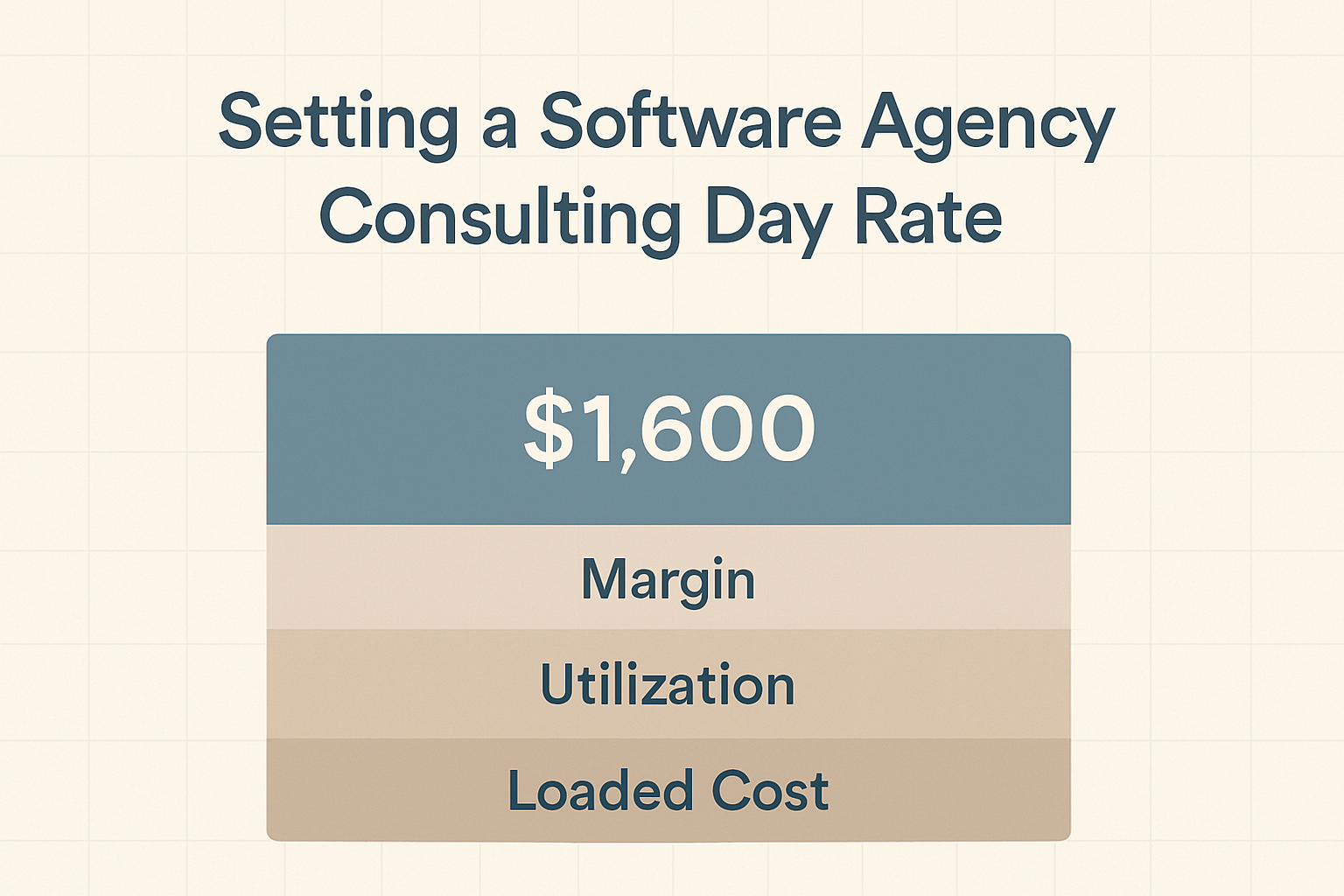
Software Consulting Rates in 2026: Set an Agency Rate That Holds
Set your software consulting rate from the bottom up: loaded cost, utilization, margin, then compare to market. Plus the 2026 AI-native twist that makes hourly billing leak your tooling gains.