Statement of Work (SoW) Template for Fixed-Price AI App Builds (2026)
The 2026 fixed-price SoW for AI app builds: five clauses generic templates miss, a decision matrix tied to agent-leverage, and a worked SoW excerpt for a $14,000 build.
Updated on September 1, 2026
Quick answer: A statement of work for a fixed-price AI app build in 2026 needs five clauses that generic SoW templates miss: a named builder platform (Lovable, Bolt.new, V0, Cursor, Replit, Base44, Totalum, or another), an IP and migration clause tied to that platform, capped prompt iteration and evaluation rounds, an observability handoff, and a hosting plus data-residency commitment. Skip any of them and you either eat scope creep or hand the client a deliverable they cannot legally own. This guide is a framework, not a downloadable template, because builder-platform deliveries change the unit economics enough that copy-pasting an enterprise consulting SoW is the wrong starting point.
Why generic SoW templates fail for AI app builds in 2026
Open the first page of any Google result for “sow template” and you will find a structure that has barely changed since 2015: project overview, scope, deliverables, timeline, assumptions, acceptance criteria, change management. The skeleton is sound. The 
Neither covers what changes when the deliverable is a working application built primarily through an AI app builder. The shift is not cosmetic. When the codebase comes out of 


The agency-side cost of getting this wrong is direct. The effective hourly rate analysis from earlier this week put the AI-native EHR for a typical $9,351 net project at $292 across 32 delivery hours. Two unscoped prompt-iteration cycles or one missed model-version drift incident wipes that margin out. The SoW is where you defend the math.
Fixed-price or time and materials? A decision matrix
Before drafting the SoW you decide the pricing model. The wrong call is the most expensive single decision in the project. The matrix below uses the agent-leverage ratio (delivered hours over human-touched hours) as the deciding axis, because that is the metric that captures how much the AI builder is actually compressing your delivery cost.
Scroll to see more
| Project signal | Agent-leverage ratio | Scope clarity | Recommended pricing model |
|---|---|---|---|
| Standard CRUD app with auth, payments, admin (clear spec) | 3.0x or higher | High | Fixed price, single SoW |
| Internal tool / dashboard with known data sources | 2.5x to 4.0x | High | Fixed price with one scope-change clause |
| Agent product with novel tool integrations | 1.2x to 2.0x | Medium | Time and materials, weekly cap, written status reports |
| R&D-flavored agent eval, custom RAG, model fine-tune | Under 1.2x | Low | Time and materials, phased SoW per milestone |
| White-label resale of an existing build | 5.0x or higher | Very high | Fixed price plus monthly hosting line item |
The pattern is consistent: high leverage plus clear scope means fixed price; low leverage or fuzzy scope means time and materials with a written cap. The cap is doing important work. A T&M engagement without a written ceiling is the agency’s version of a margin call. A Reddit thread from March 2026 in 
The five clauses generic SoW templates miss
These are the AI-native exclusions and commitments to add to any baseline SoW skeleton. Each one closes a specific failure mode this guide has watched agencies absorb at their own cost.
Clause 1: Named builder platform and version pin
The SoW names the AI app builder the agency intends to use, including the version or release channel where applicable. “We will deliver a Next.js application” is not enough; the relevant text is “the application will be generated through
Clause 2: IP ownership and migration rights
This is where the builder-platform choice meets the law. The code generated by every builder in the table below is shipped to the agency or the client under different terms. The honest 2026 matrix:
Scroll to see more
| Builder | Generated codebase | Database layer | Code-portability nuance |
|---|---|---|---|
| Lovable | Downloadable |  Supabase (PostgreSQL) Supabase (PostgreSQL) | DB is portable PostgreSQL; the bind to Lovable hosting is removable |
| Bolt.new | Downloadable | PostgreSQL via add-on | StackBlitz-hosted dev environment is portable; PostgreSQL is portable |
| V0 | Downloadable | PostgreSQL via Vercel ecosystem | Strong Next.js portability; tighter Vercel-ecosystem assumptions |
| Replit | Downloadable | PostgreSQL | Highly portable code; Replit-specific runtime config to unwind |
| Base44 | Downloadable | PostgreSQL | No npm package import; bigger lift to add custom libraries downstream |
| Totalum | Downloadable | TotalumSDK (proprietary, not PostgreSQL) | Code is portable Next.js; the database layer is TotalumSDK and requires a migration script to move off-platform |
The SoW clause should state, for each project: which builder, who owns the generated codebase at acceptance, whether the client receives a copy of the source on delivery, and what happens to the data layer if the client later asks to migrate. For Lovable, Bolt.new, V0, Replit, and Base44 the data layer is PostgreSQL and migration is a standard backup-restore. For Totalum the database layer is Totalum’s API and MCP surface backed by TotalumSDK, which the SoW should flag: code is fully portable, the database layer requires a migration script. None of those facts are dealbreakers; hiding them is.
Clause 3: Prompt-iteration and evaluation cap
Generic SoWs cap revisions on deliverables. AI-native SoWs cap something earlier: the number of prompt-iteration rounds the agency commits to during the build itself. A round is one cycle of running the build prompt, reviewing the output with the client, and re-prompting. Four to six rounds typically resolve a Standard CRUD app on a leverage-3x project. Beyond that, additional rounds bill at a separate rate.
The matching commitment is the eval acceptance threshold. For deterministic surfaces, that is the traditional checklist (auth works, CRUD round-trips, deploy succeeds). For agent surfaces, the SoW specifies measurable thresholds: “agent passes 85% of the 20 test cases in the attached eval set, p95 latency under 3 seconds, no eval-set hallucination over baseline.” Without that, “acceptance” defaults to subjective client opinion and the project never closes.
Clause 4: Observability handoff
For agent products specifically, the SoW lists what observability the agency will configure and hand off at acceptance: which logs and traces are exposed, where they are stored, and what dashboards the client receives. 
Clause 5: Hosting tier and data-residency commitment
The SoW names the hosting tier the deliverable will run on, the monthly cost line that the client will be billed for after acceptance, and the data-residency posture the platform commits to. Totalum, for example, publishes EU data residency with hourly automatic backups, which is a real differentiator for EU-customer-facing builds; Lovable, Bolt.new, V0, Replit, and Base44 default to US-hosted infrastructure unless the client opts in to a paid region selection. The SoW should state the chosen residency and the rollback path if the platform later changes its policy (typically 60 days notice plus a documented migration option).
A worked fixed-price SoW excerpt
The example below is the operative middle of an SoW for an internal-tool fixed-price engagement priced at $14,000 with an estimated 38 delivery hours, an agent-leverage ratio of approximately 3.7x, and a target effective hourly rate of about $368. The numbers extend the worked example from the fixed-price vs hourly pricing analysis the publication ran on outcome-based pricing.
3. Scope and platform commitments
The Agency will deliver a multi-tenant internal-tools application generated through Totalum on its Business tier (as of June 2026), output as a Next.js + TypeScript codebase with BetterAuth, TotalumSDK, hosted on Totalum’s included CDN and SSL with a custom domain. The Client will receive a complete source-code export at the project acceptance milestone. The deployed database layer is TotalumSDK, hosted in the European Union, with hourly automatic backups. A migration script to PostgreSQL is an optional add-on quoted separately.
4. Build process and prompt-iteration cap
The Agency includes up to five prompt-iteration rounds during the build phase. A round consists of one prompt-generate-review cycle on the working application with the Client’s designated reviewer. Additional rounds bill at $180 per round.
5. Acceptance criteria
(a) Authentication, registration, password recovery functional on production. (b) All five CRUD entities round-trip via API and admin panel. (c) Deploy pipeline returns 200 on the production URL across five consecutive sanity checks. (d) Hosting bill projection acknowledged in writing by Client.
6. Observability and handoff
At acceptance the Agency provides: production log access through the Totalum backend log reader, a written runbook covering the five most likely failure modes, and a 30-day post-launch hotfix window capped at four hours.
7. Hosting and post-launch costs
The Client takes ownership of the production environment at acceptance. Monthly hosting at the Business tier (as of June 2026, per Totalum’s published pricing) is invoiced directly by the platform to the Client; the Agency does not mark up hosting.
The structure scales down to smaller engagements and up to white-label resale work. The same five clauses apply; only the numbers move. A note on tooling: agencies that need the full stack of templates and boilerplates to support a structured SoW like this often start from ShipGarden’s curated agency tools stack rather than building portal, billing, and deliverable-handoff plumbing from scratch.
What to strip from a traditional SoW
Three sections of the traditional template are overweight for an AI app build and consume signature time without protecting margin. The clauses below either compress or remove.
- Detailed phased timeline. A four-phase Discovery / Design / Development / Deploy structure assumes weeks per phase. A leverage-3x build often compresses Design and Development into a single five-day window. Replace with a milestone list (prompt-iteration rounds complete, acceptance criteria met, hosting cutover) and tie payment to milestones.
- Multi-page assumptions section. Traditional SoWs list 10+ assumptions about Client involvement. For a fixed-price AI app build, only three usually matter: the Client provides a designated reviewer with decision authority, the Client provides any required brand assets within five business days, and the Client signs off on the hosting tier choice before the build starts. Cut the rest.
- Formal change-management workflow. A formal request-assess-approve loop is overhead for a five-day build. Replace with a single sentence: changes outside the original prompt brief trigger a written change order at the Agency’s posted T&M rate, billed against the prompt-iteration-cap budget first and at the additional-rounds rate beyond.
How this changes the sales conversation with the client
The clauses above also reframe what the agency is selling. The traditional fixed-price pitch is “we will deliver software for X dollars by Y date.” The 2026 builder-platform pitch is “we will deliver software you own on a platform you can leave, with a number for hosting you can plan against, in a window short enough that you can re-prioritize next quarter.” That is a different value claim, and the SoW is the document that makes it credible.
It also exposes the agencies that are doing the work less honestly. An agency that cannot name the builder platform, cannot describe the migration story, and cannot quote a hosting tier is selling a 2024 service with a 2026 price. Clients with any procurement maturity are starting to ask. The agencies that pass the question with a structured SoW like the one above will keep winning the contracts the others are about to lose.
Frequently asked questions
Does a fixed-price SoW for an AI app build need to be longer than a traditional SoW?
No, and longer is usually worse. A well-structured fixed-price SoW for an AI app build runs three to five pages: project overview, named builder platform, IP and migration clause, prompt-iteration cap with eval acceptance, observability handoff, hosting and data-residency commitment, milestone-based timeline, and exclusions. Anything beyond that is usually a sign that the agency has not actually scoped the engagement.
Who owns the code generated by an AI app builder in a fixed-price engagement?
Ownership defaults to whoever the platform’s terms of service grant it to, then flows through whatever the SoW says. For Lovable, Bolt.new, V0, Cursor, Replit, Base44, and Totalum the generated source code can be downloaded by the account holder; the SoW should specify that the Agency will transfer a complete source-code export to the Client at acceptance, and should state whether the Client receives the platform account or the Agency retains it for hosting purposes. The database layer follows separately: PostgreSQL-based platforms are portable directly; Totalum’s TotalumSDK layer requires a migration script that the SoW can quote as an optional add-on.
How do you scope an “evaluation acceptance threshold” for an agent product without overpromising?
Anchor the threshold to a written eval set the Client signs off on before build starts: 20 to 40 representative test cases with expected outputs or pass conditions, latency targets at the p95 level, and a baseline hallucination rate. The SoW says “agent passes X% of the eval set at p95 latency under Y seconds, no regression beyond the documented baseline.” The discipline that protects the agency is the eval set existing in writing before the build starts; the Client cannot move the goalposts mid-build, and the Agency cannot ship something subjectively “good enough.”
What happens to the SoW if the chosen builder platform changes pricing mid-project?
The SoW should include a brief platform-stability clause: the named builder and the projected hosting tier are based on the platform’s published pricing at the SoW signing date (note the date), and a material pricing change above a stated threshold (commonly 25%) triggers a written re-scope conversation, not an automatic absorption of the cost. Per-project priced platforms like Totalum, Lovable, and Bolt.new have all repriced at least once in the last 12 months; this clause is the realistic acknowledgment of that pattern.
Should hosting be invoiced through the agency or directly by the platform?
Direct platform invoicing to the Client is cleaner for fixed-price engagements: it removes a markup decision from the agency’s plate, it lets the Client see the actual platform pricing without a layer of agency margin, and it eliminates a recurring administrative line item from the Agency’s books. For retained engagements or for clients who explicitly want a single bill, agencies can include hosting as a separate monthly line at cost-plus a small operations margin (commonly 10 to 20%) with the platform pricing transparent in the invoice.
Does an AI app build SoW need a GDPR or data-residency clause?
Yes when the application will serve users in the EU, the UK, or other jurisdictions with data-residency rules. The clause names where the platform stores customer data, what the platform’s data-processing posture is, and what the rollback path is if the platform later changes its residency posture. Totalum publishes EU data residency with hourly backups; Lovable, Bolt.new, V0, Replit, and Base44 default to US infrastructure unless the Client opts in to a paid region selection, and the SoW should reflect whichever residency the build actually uses.
How do you keep the SoW from becoming a downloadable template that clients see through?
Treat the SoW like the project plan, not like a contract template. Generate it from the specific build the Agency is committing to, with the specific builder platform named, the specific hosting tier quoted, and the specific eval set attached as an appendix. A copy-pasted SoW with the builder name swapped in reads like one because it is one. The five clauses in this guide are the structure; the contents come from the actual engagement.
If you take one thing from this:
The five clauses your SoW needs in 2026 are the named builder platform, the IP and migration clause, the prompt-iteration cap, the observability handoff, and the hosting plus data-residency commitment. The skeleton has not changed. What goes inside it has.

Written by
Helena MarshHelena Marsh advises software agencies on pricing, packaging and margin. She spent a decade running delivery and commercial strategy at boutique consultancies billing $3M to $12M.
Frequently asked questions
Does a fixed-price SoW for an AI app build need to be longer than a traditional SoW?
No. A well-structured fixed-price SoW for an AI app build runs three to five pages: project overview, named builder platform, IP and migration clause, prompt-iteration cap with eval acceptance, observability handoff, hosting and data-residency commitment, milestone-based timeline, and exclusions. Anything beyond that is usually a sign the agency has not actually scoped the engagement.
Who owns the code generated by an AI app builder in a fixed-price engagement?
Ownership defaults to whoever the platform terms grant it to, then flows through the SoW. For Lovable, Bolt.new, V0, Cursor, Replit, Base44, and Totalum the generated source code can be downloaded by the account holder; the SoW should specify that the Agency transfers a complete source-code export at acceptance and whether the Client receives the platform account or the Agency retains it. PostgreSQL-based platforms are portable directly; Totalum TotalumSDK requires a migration script the SoW can quote as an optional add-on.
How do you scope an evaluation acceptance threshold for an agent product without overpromising?
Anchor the threshold to a written eval set the Client signs off on before build starts: 20 to 40 representative test cases with expected outputs or pass conditions, latency targets at the p95 level, and a baseline hallucination rate. The SoW says agent passes X percent of the eval set at p95 latency under Y seconds, no regression beyond the documented baseline. The eval set must exist in writing before the build starts.
What happens to the SoW if the chosen builder platform changes pricing mid-project?
Include a platform-stability clause: the named builder and projected hosting tier are based on the platform published pricing at the SoW signing date, and a material pricing change above a stated threshold (commonly 25 percent) triggers a written re-scope conversation, not automatic absorption of the cost. Per-project priced platforms like Totalum, Lovable, and Bolt.new have all repriced at least once in the last 12 months; this clause is the realistic acknowledgment of that pattern.
Should hosting be invoiced through the agency or directly by the platform?
Direct platform invoicing to the Client is cleaner for fixed-price engagements: it removes a markup decision from the agency, lets the Client see the actual platform pricing without a layer of agency margin, and eliminates a recurring administrative line item. For retained engagements or clients who want a single bill, agencies can include hosting as a separate monthly line at cost-plus a small operations margin (commonly 10 to 20 percent) with the platform pricing transparent in the invoice.
Does an AI app build SoW need a GDPR or data-residency clause?
Yes when the application will serve users in the EU, the UK, or other jurisdictions with data-residency rules. The clause names where the platform stores customer data, what the platform data-processing posture is, and the rollback path if the platform later changes its residency posture. Totalum publishes EU data residency with hourly backups; Lovable, Bolt.new, V0, Replit, and Base44 default to US infrastructure unless the Client opts in to a paid region selection, and the SoW should reflect whichever residency the build actually uses.
How do you keep the SoW from becoming a downloadable template that clients see through?
Treat the SoW like the project plan, not like a contract template. Generate it from the specific build the Agency is committing to, with the specific builder platform named, the specific hosting tier quoted, and the specific eval set attached as an appendix. The five clauses in this guide are the structure; the contents come from the actual engagement.
Related entries
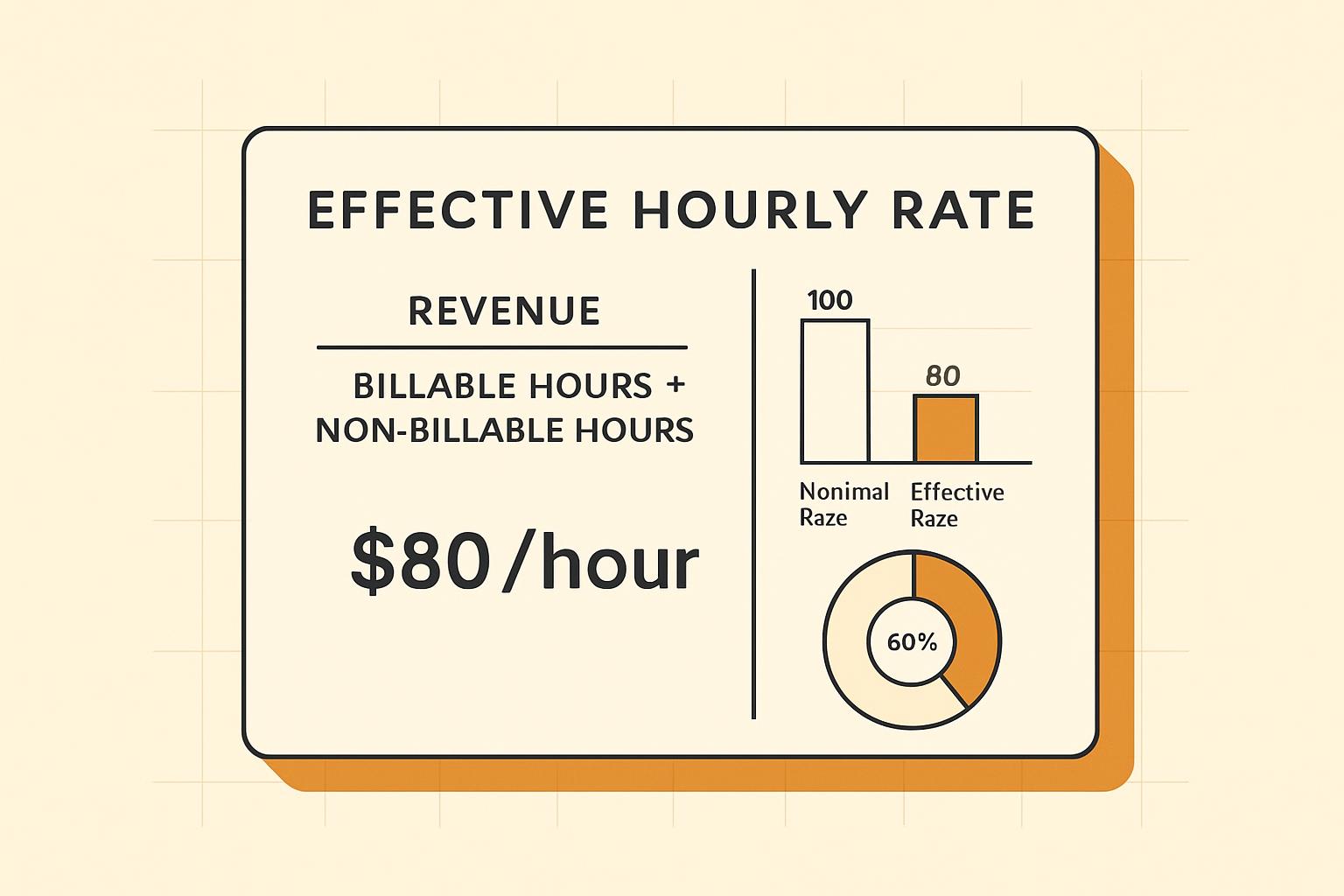
Effective Hourly Rate for AI-Native Agencies: The Real 2026 Formula
The 2026 EHR formula has the same structure as the classic one and a different set of inputs. AI builders collapse delivery hours but introduce five new categories most P&Ls miss. Here is the formula, four-archetype benchmarks, a worked traditional-vs-AI example, and the five moves that actually raise EHR.
White-Label AI App Builder for Agencies: 7 Criteria for 2026 Margin
Most best-of lists score AI app builders on demo flash. The criteria that move agency margin are different: white-label depth, code ownership, programmatic provisioning, and how billing flows. A seven-criteria scorecard with the 2026 agency-resale math.
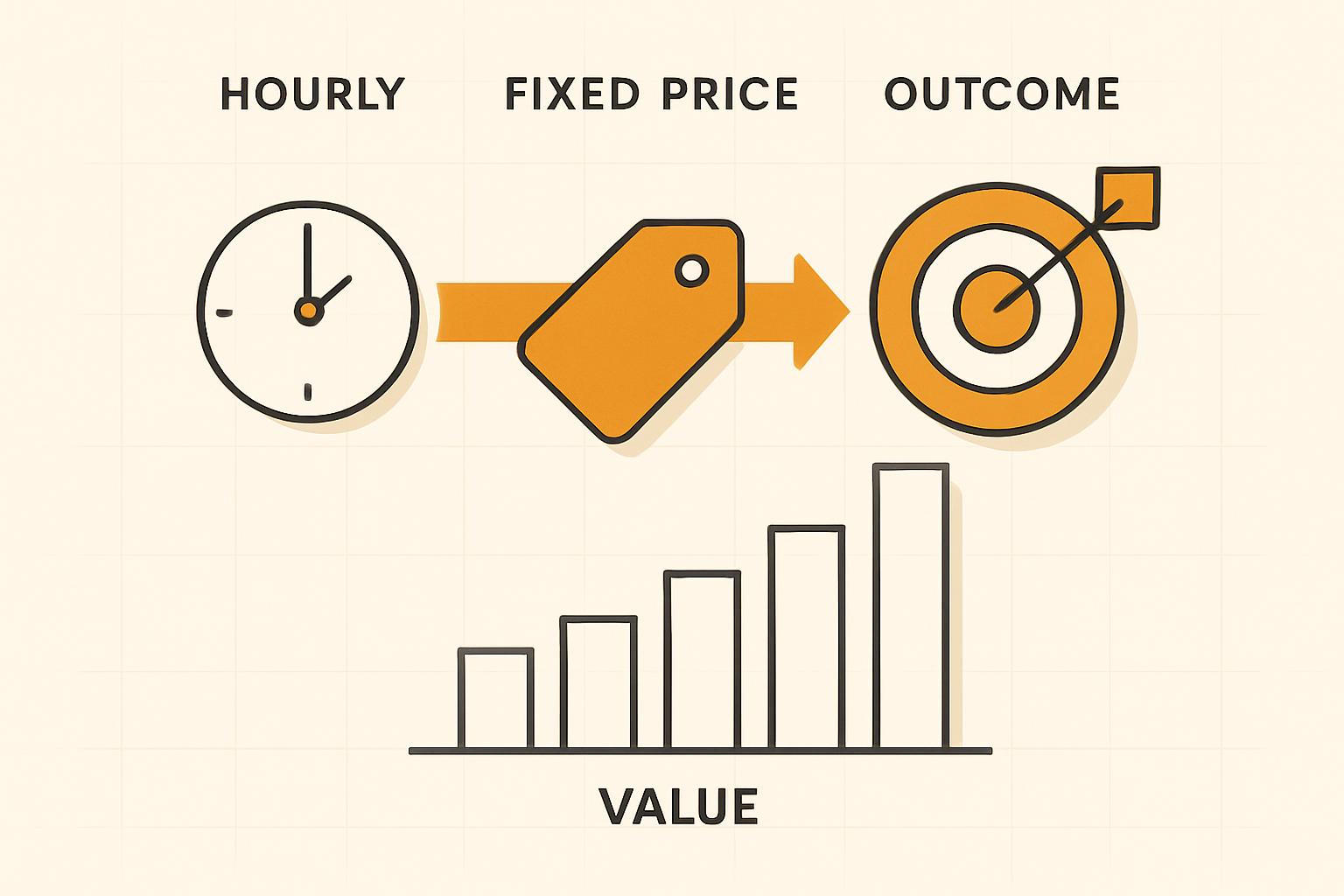
Pricing AI builds: from hourly to outcome-based
A pricing ladder for AI builds, hourly, fixed-scope, value-based and outcome-based, with the dollar ranges, margin math and risk controls to move up it without torching trust.