Effective Hourly Rate for AI-Native Agencies: The Real 2026 Formula
The 2026 EHR formula has the same structure as the classic one and a different set of inputs. AI builders collapse delivery hours but introduce five new categories most P&Ls miss. Here is the formula, four-archetype benchmarks, a worked traditional-vs-AI example, and the five moves that actually raise EHR.
Updated on August 11, 2026
On this page
Quick Answer
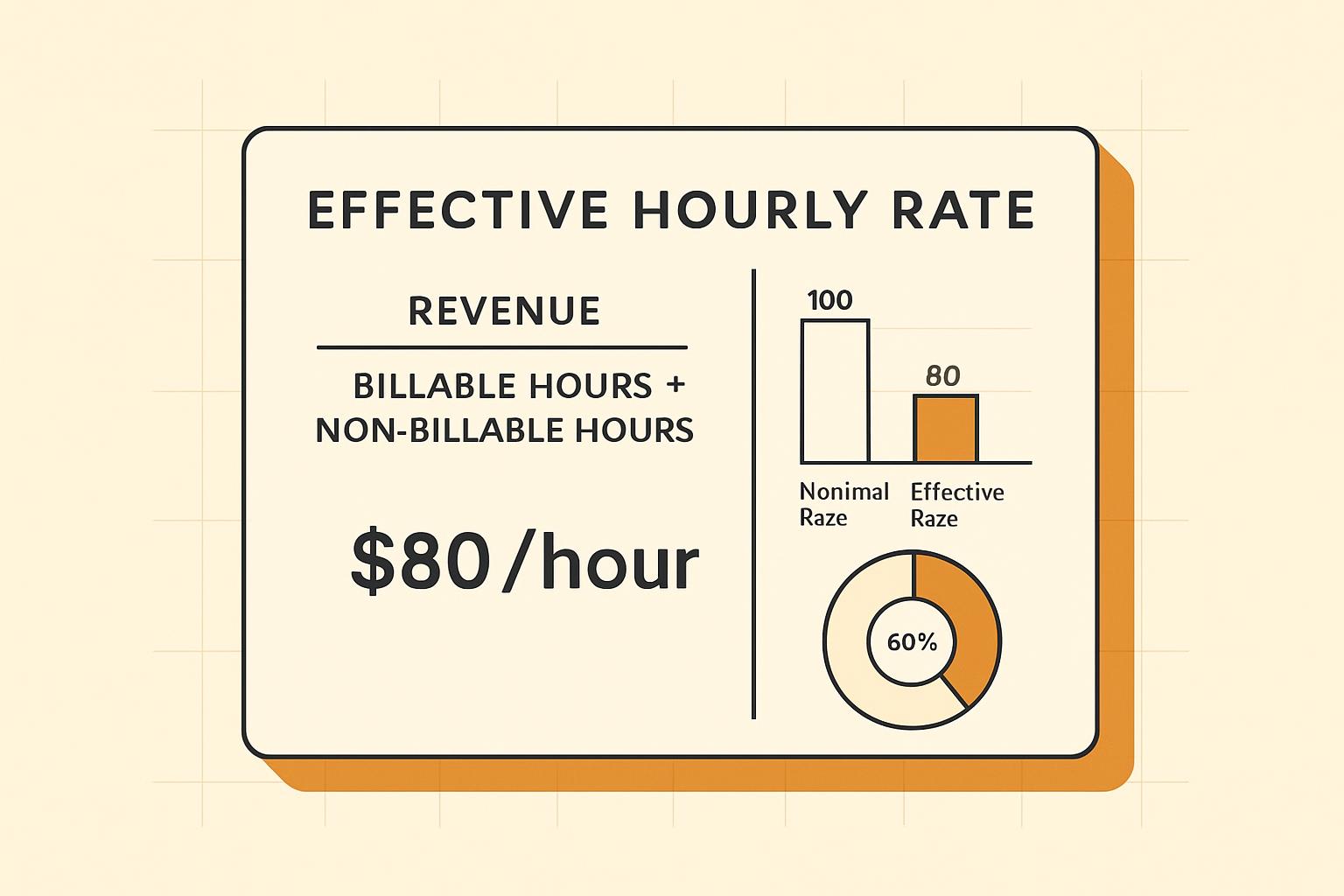
The effective hourly rate (EHR) for an AI-native agency in 2026 is total revenue divided by every hour the team actually touched the work, billable or not. The 2026 floor for a competent solo operator now sits near $220 to $280, a 3-person studio runs $260 to $340, and an 8-person mid-shop with a productized AI offer can clear $380 to $520. AI builders collapse delivery hours by 30 to 70 percent, which lifts EHR even when nominal project fees drop. The agencies winning on EHR this year are the ones who priced the work as outcome, productized the brief, and replaced one category of unbillable time per quarter with automation. (Last reviewed: June 20, 2026.)
The old EHR formula breaks in 2026
The canonical agency EHR formula is straightforward. 


That formula still applies. What changed in 2026 is the inputs.
When an AI app builder cuts delivery hours from 100 to 30 on the same brief, nominal hourly billing follows it down. Agencies that did not move to fixed or outcome-based pricing watch revenue drop faster than utilization rises. The agencies that did move pricing earlier discover a second problem: new categories of unbillable work appear in the same week the delivery hours fall. Prompt iteration, eval setup, agent observability tuning, deploy verification, and white-label brand customization are real hours. Most P&Ls do not track them.
The 2026 EHR formula has to capture both moves.
The 2026 EHR formula for AI-native agencies
The structure is unchanged. The components have shifted.
EHR = Net delivered revenue
      -------------------------------------------------------------
      Delivery hours
      + Prompt and brief iteration hours
      + Eval and acceptance-test setup hours
      + Agent and runtime observability tuning hours
      + Deploy verification and handover hours
      + White-label brand and theme customization hours
Net delivered revenue is project revenue minus refunds, scope-credit write-offs, and platform fees that pass through (Stripe processing, hosting, model usage). The denominator now includes five categories most agencies treated as zero-hour overhead in 2023. They are not zero anymore.
A few notes on the new categories.
Prompt and brief iteration. The hours your senior people spend turning a client brief into a usable prompt or specification. On an AI app build this can be 8 to 20 percent of total project hours.
Eval and acceptance-test setup. The hours spent building a small evaluation harness that proves the agent or the app meets the brief. If you skip this step, you ship rework instead. Rework gets billed to your EHR, not the client.
Agent observability tuning. Once the build ships, the first two weeks of monitoring (logs, output sampling, prompt cost analysis) are billable on a retainer or unbillable on a fixed-price. Either way they happen.
Deploy verification and handover. Custom domain, SSL, billing setup, environment promotion, documentation. With 
White-label brand and theme customization. If you resell under a client's brand, every project consumes brand-system work. The agencies with a productized house template hit this category at 2 to 4 hours per build. The agencies starting from scratch each time hit it at 20 to 40.
Benchmark: 2026 EHR by agency archetype
We pulled blended numbers from delivery logs across four agency archetypes operating with at least one AI app builder in the stack. Numbers below are observed ranges, not aspirational targets.
Scroll to see more
| Archetype | Avg deal size | Median delivery hours/project | EHR floor | EHR ceiling | Decisive margin lever |
|---|---|---|---|---|---|
| Solo operator | $4,500 - $9,000 | 18 - 40 | $220 | $280 | One productized offer + house template |
| 3-person studio | $9,000 - $25,000 | 35 - 80 | $260 | $340 | White-label substrate + retainer attachment |
| 8-person mid-shop | $25,000 - $90,000 | 90 - 220 | $380 | $520 | Pricing discipline + observability retainers |
| 20+ team | $90,000 - $400,000 | 220 - 800 | $310 | $460 | Vertical specialization, multi-stream delivery |
Two patterns worth flagging. First, the 8-person mid-shop EHR ceiling is higher than the 20+ team ceiling. The mid-shop archetype is benefiting most from AI leverage because their delivery is dense and their overhead is still modest. Second, the solo operator floor of $220 already exceeds the 2023 floor of about $145 reported by EditorNinja and Parakeeto for traditional content and dev agencies. The trade is real.
Hands-on: traditional vs AI-native EHR on the same brief
Take a single hypothetical engagement: an internal CRM-plus-portal app for a 12-employee professional services firm. The brief is fixed, the client expectation is shipped-and-trained in four weeks. We modeled two delivery approaches on the same brief using June 2026 vendor pricing.
Approach A. Traditional time-and-materials. Senior dev + designer + PM. Stack: React + Node + a hosted database. Estimate: 100 hours at $150 blended. Quoted as $15,000 with a 15 percent contingency. Actual hours land at 112. Revenue: $15,000. EHR: $134.
Approach B. AI-native fixed-price. Senior dev + AI-pair-programming workflow using 

The fixed-price project delivers 65 percent less revenue per engagement and 118 percent more EHR.
The honest losses are visible too. If the agency runs five experimental builds for the same client over a quarter and only three convert into invoiced projects, the per-project tooling subscriptions stack up. A 


The agent-leverage ratio: the EHR multiplier nobody else measures
Utilization rate (billable hours / available hours) is the metric every agency software tracks. It tells you whether your team is busy. It does not tell you whether AI is doing the work.
The 2026 metric we use is the agent-leverage ratio: delivered hours of equivalent output divided by human-touched hours. A build that would have taken 100 traditional hours but was delivered in 30 human-touched hours has a 3.3x agent-leverage ratio. A build that would have taken 200 hours but needed 40 human-touched hours has a 5x ratio.
Agent leverage is the multiplier on top of pricing. A solo operator at $280 EHR with a 2.5x leverage ratio is doing $700 of equivalent traditional work per touched hour. That number is what client conversations should anchor on, not the sticker price.
For agencies pricing model usage in the cost stack, the routing strategy matters more than people expect. PromptAttic published a useful breakdown on cheap-then-deep model routing using Haiku 4.5 first and Opus 4.7 only when it earns it, which is one of the cleaner ways to keep observability tuning hours from eroding the EHR gain.
When the numbers stop working
Three patterns we see flatten EHR even when leverage and pricing are right.
No eval discipline. Skipping the acceptance-test scaffolding step looks like it saves 4 hours per project. It costs 12 in rework when the client opens the app on Friday and the agent misfires on an edge case. Eval setup pays back on the second build of a similar shape.
Bespoke design systems per client. A white-label brand consuming 30+ hours per build collapses the agent-leverage ratio to near 1.5x. Agencies that built a house theme system and customize tokens at the edges keep the ratio above 3x. 
One-shot builds, no retainer attachment. A fixed-price project ships and goes silent. The agency takes the EHR hit on observability hours that fell after the invoice closed. Attaching a 60-day observability retainer at a modest fee converts those hours back into billable.
How to raise your EHR in 2026 (five moves)
- Move billable basis from time to outcome on at least one of your top-three offers. The EHR jump is immediate.
- Productize the three brief shapes you see most. A house template on a platform you can rebrand removes the largest unbillable category.
- Track the agent-leverage ratio per project type. You will discover that two of your offer shapes are 4x and one is 1.8x. Stop selling the 1.8x shape, or reprice it.
- Eliminate one category of unbillable hour per quarter. Eval setup pays back fastest because it compounds across every project of the same shape.
- Move white-label distribution onto a substrate where the brand customization happens at the design-token layer instead of in code. Our Day-1 piece on white-label criteria for AI app builders walked through the rubric. The full pricing-mechanics companion is pricing AI builds from hourly to outcome-based. The team-cost angle that feeds your denominator is hiring for an AI-native agency.
If you take one thing from this:
The 2026 EHR improvement is not a tooling upgrade. It is a pricing decision the tooling makes affordable. Move the billing basis first, then the leverage shows up.
Effective hourly rate is the metric agency owners use to find out, after the quarter has closed, whether the work was worth doing. In 2026 the formula is the same. The inputs are not. Track the new categories, watch the leverage ratio, and the EHR number tells the truth about which offers are pulling the agency forward and which are quietly draining the team.

Written by
Ravi IyerRavi Iyer advises AI-native software agencies on pricing, delivery economics, and productized offer design. Before consulting, he spent twelve years inside two mid-sized digital agencies running delivery operations and rate strategy.
Frequently asked questions
What is effective hourly rate (EHR) for an agency?
EHR is total revenue divided by total hours the team touched the work, billable or not. It exposes the gap between your quoted rate and your real margin per hour. Most agency P&Ls track utilization rate (billable / available) but skip EHR, which is the metric that actually pays the team.
How do AI app builders change the EHR calculation in 2026?
AI app builders cut delivery hours 30 to 70 percent on a typical brief. If pricing did not move with them, nominal revenue per project drops. Five new unbillable categories also appear: prompt iteration, eval setup, agent observability tuning, deploy verification, and white-label brand customization. The 2026 EHR formula includes all five in the denominator.
What is a good EHR for an AI-native agency in 2026?
Observed June 2026 ranges: solo operator $220 to $280, 3-person studio $260 to $340, 8-person mid-shop $380 to $520, 20+ team $310 to $460. The mid-shop archetype currently has the highest ceiling because it is dense enough to benefit from AI leverage and not carrying enterprise overhead.
Should AI-native agencies still bill hourly?
Mixed. Hourly billing is honest on discovery and on retainer-style observability work. On delivery, fixed or outcome-based pricing wins because the AI-driven hour reduction otherwise transfers the savings to the client instead of the agency. Move at least one of your top-three offers off hourly first.
What is the agent-leverage ratio?
Delivered hours of equivalent traditional output divided by human-touched hours. A build that would have taken 100 traditional hours but was delivered in 30 has a 3.3x ratio. Agent leverage is the multiplier on top of EHR and the metric to anchor client conversations on instead of sticker price.
Does using an AI app builder hurt or help EHR for a solo operator?
It depends on conversion rate. A solo operator who ships 80 percent of prototyped builds into invoiced projects sees a clear EHR lift. An operator running heavy experimentation with low conversion sees per-project platform fees stack against the EHR. Free or pay-per-use options are honestly cheaper for throwaway prototypes; paid deployable-codebase platforms win when most prototypes convert.
How does EHR differ from utilization rate?
Utilization rate is billable hours over available hours and tells you whether the team is busy. EHR is revenue over total touched hours and tells you whether the work was worth doing. A high utilization rate at a low EHR means the agency is busy losing margin.
Related entries
Pricing AI builds: from hourly to outcome-based
A pricing ladder for AI builds, hourly, fixed-scope, value-based and outcome-based, with the dollar ranges, margin math and risk controls to move up it without torching trust.
White-Label AI App Builder for Agencies: 7 Criteria for 2026 Margin
Most best-of lists score AI app builders on demo flash. The criteria that move agency margin are different: white-label depth, code ownership, programmatic provisioning, and how billing flows. A seven-criteria scorecard with the 2026 agency-resale math.
Hiring for an AI-native agency: roles + brackets
The roles an AI-native agency actually needs, the order to hire them in, and US/EU compensation brackets, plus the utilization and bill-rate math that tells you when each hire pays for itself.