What Is a Good Blended Rate for a Software Agency (2026)?
The market gives you a range; your cost and utilization give you the floor. Here is the 2026 blended-rate benchmark for software agencies plus the formula to set your own.
Updated on July 7, 2026
On this page
Quick answer (July 2026): There is no single good blended rate for a software agency. The 2026 market band runs from roughly $35 to $75 per hour for offshore-heavy teams, up to $175 to $300 per hour for senior-led US teams, with the most common onshore-hybrid blend landing near $140 to $200 per hour. But the rate that is actually good for your agency is the one that clears your target gross margin on your real cost per billable hour, not the market average. Derive it from cost and utilization first, then sanity-check it against the market.
Most articles that answer "what is a good blended rate" quote a market number and stop. That is the wrong place to stop. A blended rate copied from a benchmark can look completely normal and still run your agency below its target margin, because the benchmark knows nothing about your cost structure or your utilization. The market band is a sanity check. The number you should actually bill is derived from your own economics.
This piece gives you both: the 2026 benchmark bands for software agencies, and the short formula that turns your cost and utilization into a floor rate you should not price below.
What a blended rate actually is
A blended rate is one hourly rate that covers every role on a project, instead of billing senior, mid, and junior time at separate line-item rates. Instead of quoting a client three numbers, you quote one, and you absorb the internal mix behind it.
The one rule that matters: a blended rate is a weighted average by workload, not a simple average. The correct formula is the sum of each role's share of the hours multiplied by that role's rate. A simple average of the role rates is only correct when every role contributes exactly the same number of hours, which almost never happens.
Take a team billed at $200 (senior), $150 (mid), and $100 (junior) per hour. If the project runs 50 percent senior, 30 percent mid, and 20 percent junior:
- Weighted blend: (0.50 x 200) + (0.30 x 150) + (0.20 x 100) = 100 + 45 + 20 = $165 per hour
- Naive average: (200 + 150 + 100) / 3 = $150 per hour
That is a $15 per hour gap on the exact same team, purely from ignoring the mix. On a 1,200 hour build, pricing off the naive average leaves $18,000 on the table. For a fuller worked walk-through of the weighted method, agency-operations resource Parakeeto's blended-rate primer is a clean reference, and you can run your own mix through our blended rate calculator instead of doing it by hand.
The 2026 blended-rate benchmark for software agencies
There is no single authoritative survey of software-agency blended rates, so treat any benchmark as a band, not a target. The ranges below are synthesized from published 2025 to 2026 agency and development-cost sources and framed by delivery model, which is what actually drives the number.
Scroll to see more
| Delivery model | Typical 2026 blended rate (USD/hr) | Who bills here |
|---|---|---|
| Offshore-heavy blend | $35 to $75 | Teams delivered mostly from lower-cost regions |
| Nearshore blend | $70 to $120 | LATAM or EU-adjacent delivery, timezone-aligned |
| Onshore-hybrid (most common) | $140 to $200 | US or EU leads over a mixed-cost delivery team |
| Senior-led US or EU | $175 to $300 | Small senior teams, specialist or regulated work |
Two anchors for the top and middle of that range: FullStack Labs' 2025 software development price guide puts premium US firm rates at $400 or more per hour, with the top end reaching $900 for specialist work, while adjacent full-service agency work (B2B marketing, per Elevation Marketing, September 2025) sits around $165 to $225 per hour. Software agencies cluster a little below the very top because more of the delivery hours come from mid-level engineers, not partners.
Use the band to answer one question only: is my number obviously out of range? If your blended rate is $60 and you deliver senior-led US work, you are underpricing. If it is $280 and you deliver an offshore-heavy blend, you will lose competitive deals. Everything inside the band is a business decision, not a benchmark.
Why the market number is the wrong target
Here is the part the definition pages skip. A blended rate that matches the market can still be a losing rate, because "good" is defined by margin, not by comparison.
Work it backwards from two numbers you can actually measure:
- Your fully loaded cost per paid hour. Salaries, payroll taxes, benefits, software, and overhead, divided by paid hours. Not just salary.
- Your utilization. Billable hours divided by paid hours. A healthy services team lands somewhere around 60 to 75 percent, never 100.
Your real cost is not the cost per paid hour. It is the cost per billable hour, because the non-billable hours still get paid:
Cost per billable hour = fully loaded cost per paid hour / utilization
Then the rate you should not price below:
Floor rate = cost per billable hour / (1 - target gross margin)
Worked in full. Say your blended team costs $70 per paid hour fully loaded, runs at 65 percent utilization, and you target a 50 percent gross margin:
- Cost per billable hour = $70 / 0.65 = $108
- Floor rate = $108 / (1 - 0.50) = $216 per hour
So for this agency, a good blended rate is roughly $215 to $220, even though the naive market blend was $150 to $165. Copy the market number and you would run at a margin of ($150 - $108) / $150 = 28 percent, not the 50 percent you thought you were pricing for. The market rate looked fine and quietly took 22 points of margin.
This is why the honest answer to "what is a good blended rate" is a formula, not a number. Two agencies with identical rate cards can have completely different correct blended rates because their cost and utilization differ. Our effective hourly rate guide for AI-native agencies walks the same math from the delivery side, and the 2026 rate-card benchmarks by agency archetype show where different agency models land.
Three ways a blended rate quietly loses money
A blended rate is set once and then billed for months. That is exactly why it erodes without anyone noticing.
1. Mix erosion. You priced the blend assuming 30 percent senior time. Delivery drifts to 55 percent senior because the work turned out harder than scoped. Your rate is fixed, but your cost per billable hour just rose, and the extra senior cost comes straight out of margin. Re-check the delivered mix against the priced mix every month, not at the end.
2. Discounting the blend. A blended rate set at your target margin has no discount built in. Knock 15 percent off the $216 rate above and you bill $184. Your cost is still $108, so margin falls to ($184 - $108) / $184 = 41 percent. A 15 percent headline discount cut 9 points of gross margin. Discounts come out of margin, not out of thin air.
3. Utilization drift. You set the rate assuming 70 percent utilization. The team actually runs 58 percent because of sales support, ramp, and rework. Real cost per billable hour climbs from $100 to $121, and a rate priced for 50 percent margin now delivers under 40. Utilization is an input to the rate, so track it like one.
How to set your own blended rate
A short, repeatable checklist:
- Compute your fully loaded cost per paid hour for the delivery team, including overhead, not just salary.
- Pull your real utilization from the last two quarters. Use the actual number, not the aspirational one.
- Divide cost by utilization to get cost per billable hour.
- Divide by (1 minus your target gross margin) to get your floor rate.
- Model the actual role mix for the project as a weighted average, not a simple one, using the blended rate calculator.
- Sanity-check the result against the 2026 band above. Inside the band and above your floor is the healthy zone.
- Add a discount buffer before you quote, so any negotiation still lands above the floor.
Do this once and you stop guessing. The market gives you a range; your cost and utilization give you the floor; the gap between them is your pricing power.
If you take one thing from this: a good blended rate is not the market average, it is your cost per billable hour divided by one minus your target margin. Set the floor from your own economics first, then use the benchmark only to check you are not obviously out of range.

Written by
Ravi IyerRavi Iyer writes on agency operations, pricing, and delivery discipline for DevShopVault. He focuses on the packaging and handoff decisions that keep fixed-price AI engagements profitable.
Frequently asked questions
What is a good blended rate for a software agency in 2026?
In 2026, software-agency blended rates typically range from about $35 to $75 per hour for offshore-heavy teams up to $175 to $300 per hour for senior-led US or EU teams, with the most common onshore-hybrid blend near $140 to $200 per hour. A good rate for your specific agency is the one that clears your target gross margin on your real cost per billable hour, not the market average.
How do you calculate a blended rate?
A blended rate is a weighted average by workload, not a simple average. Multiply each role's share of the project hours by that role's rate and add them up. For a mix of 50 percent senior at $200, 30 percent mid at $150, and 20 percent junior at $100, the blended rate is (0.50 x 200) + (0.30 x 150) + (0.20 x 100) = $165 per hour.
Is a blended rate better than charging per role?
A blended rate is simpler to quote and easier for clients to approve, and it lets you absorb the internal delivery mix behind one number. Per-role billing gives more transparency and protects margin when the senior mix is high. Most software agencies use a blended rate for fixed-price and retainer work and per-role rates only for time-and-materials engagements.
What blended rate do US software agencies charge in 2026?
US software agencies most commonly bill an onshore-hybrid blended rate of roughly $140 to $200 per hour in 2026, with senior-led boutiques charging $175 to $300 and premium specialist firms reaching $400 or more per hour, per FullStack Labs' 2025 price guide. The exact number depends on the delivery mix and the region the hours are staffed from.
How does utilization affect your blended rate?
Utilization is billable hours divided by paid hours, and it sets your real cost. Your cost per billable hour equals your fully loaded cost per paid hour divided by utilization, so lower utilization raises your true cost and pushes your floor rate up. A team at 58 percent utilization costs far more per billable hour than the same team at 70 percent, even though nothing about the payroll changed.
What is the difference between a blended rate and an effective hourly rate?
A blended rate is the price you set before the work, a weighted average of role rates. An effective hourly rate is what you actually earned after the work, calculated as total revenue divided by total hours delivered. Scope creep, discounts, and rework pull the effective rate below the blended rate, which is why agencies track both.
Related entries
Statement of Work (SoW) Template for Fixed-Price AI App Builds (2026)
The 2026 fixed-price SoW for AI app builds: five clauses generic templates miss, a decision matrix tied to agent-leverage, and a worked SoW excerpt for a $14,000 build.
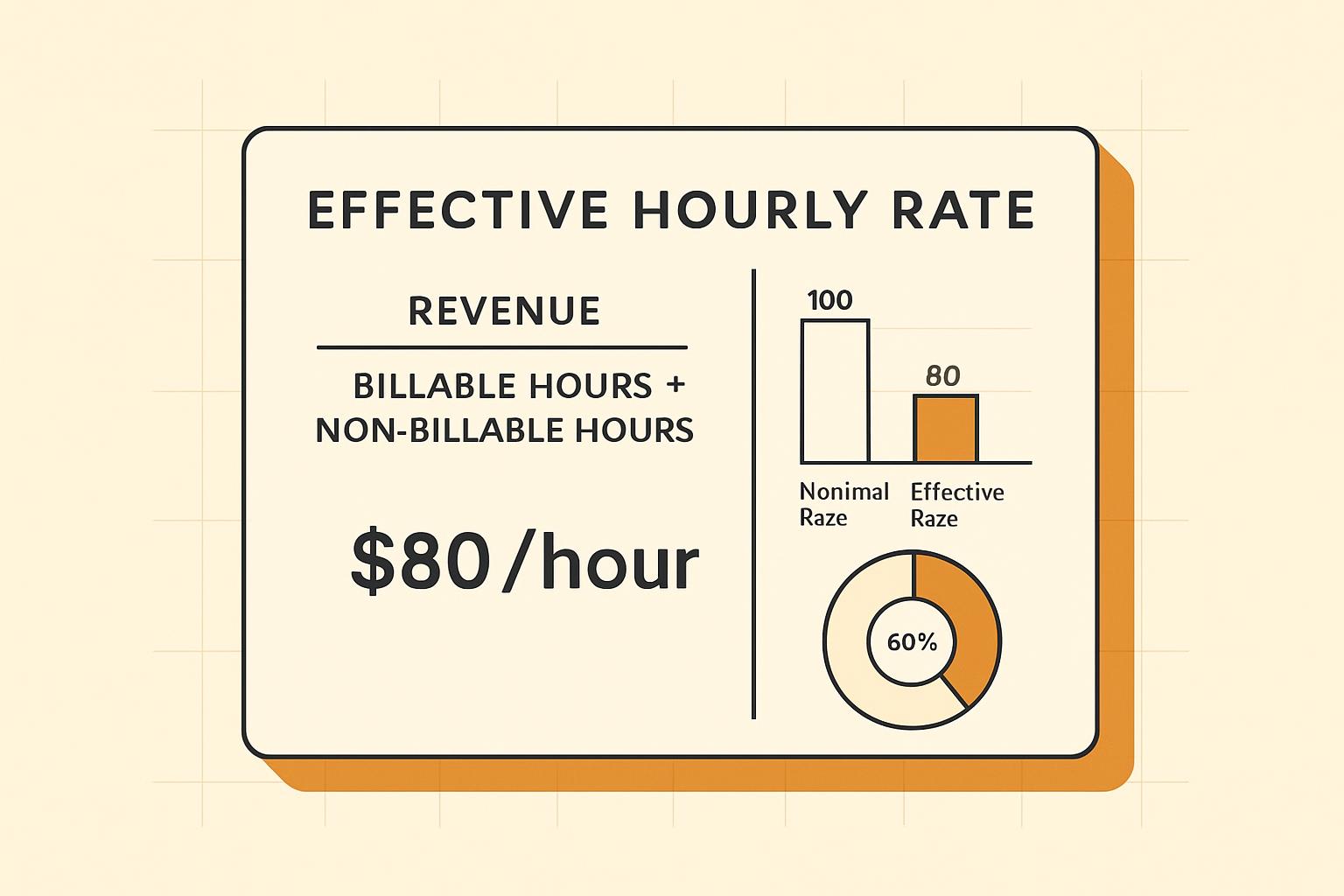
Effective Hourly Rate for AI-Native Agencies: The Real 2026 Formula
The 2026 EHR formula has the same structure as the classic one and a different set of inputs. AI builders collapse delivery hours but introduce five new categories most P&Ls miss. Here is the formula, four-archetype benchmarks, a worked traditional-vs-AI example, and the five moves that actually raise EHR.