White-Label vs Reseller vs Referral for Agencies (2026)
A decision framework for agencies choosing between white-label, reseller, and referral partnership models on the platforms behind their AI builds, with a six-axis matrix and worked margin math.
Updated on July 16, 2026
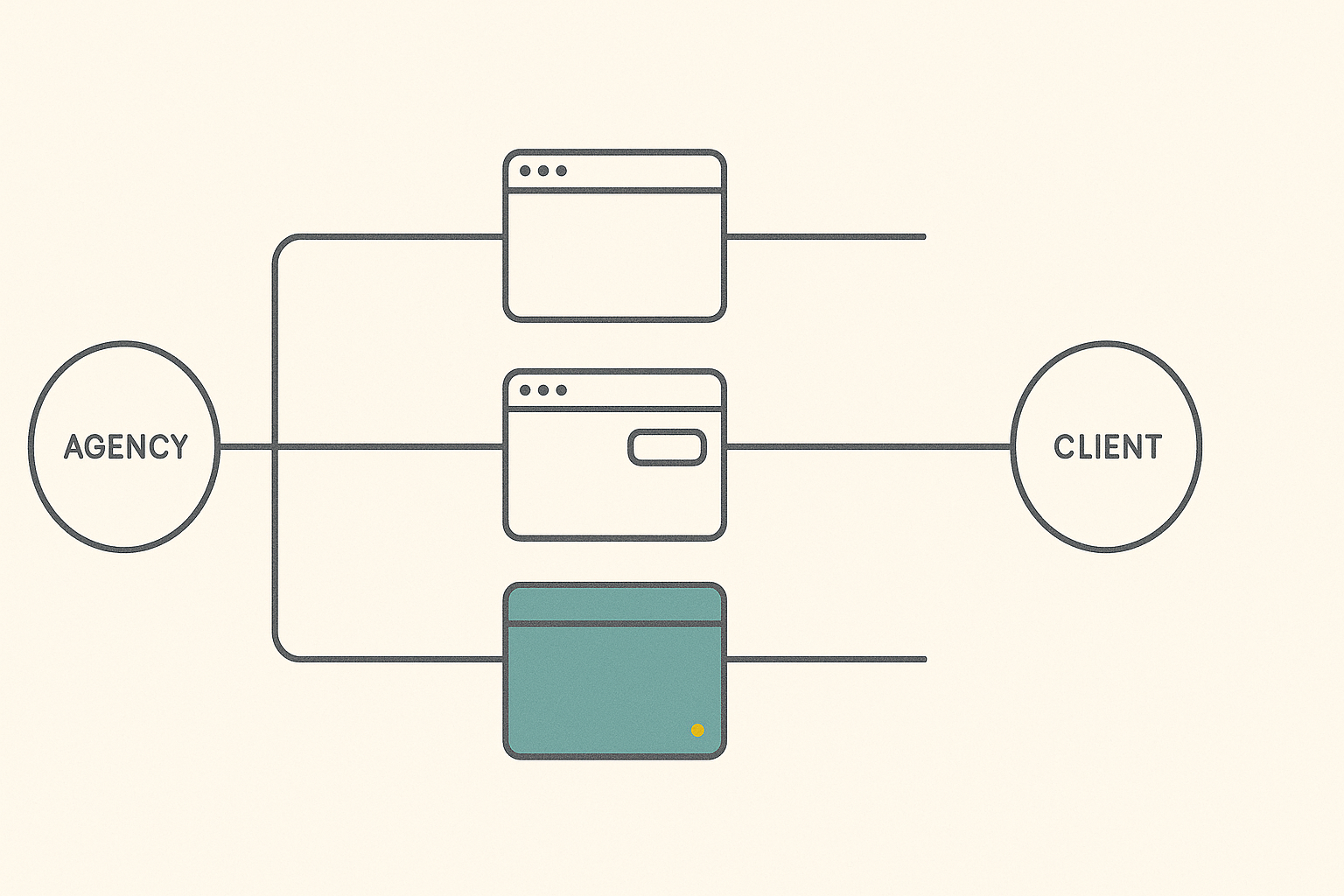
On this page
Quick Answer (2026): White-label, reseller, and referral are three different ways an agency can build on a third-party platform. Referral hands the client to the vendor for a one-time or recurring bounty. Reseller sells the vendor's product at a partner discount you keep as margin. White-label puts your brand on the vendor's product so the client only ever sees your agency. The right choice in 2026 is not the one with the highest headline margin; it is the one whose control, liability, and client-ownership terms match how you actually deliver and how you plan to exit.
The three models, defined
Agencies productizing AI app builds sit on top of a platform they did not write. How you package that platform for the client is a partnership decision, and the vocabulary matters because the contracts behind each word are very different.
- Referral. You point the client at the vendor and step back. The vendor bills the client directly. You earn a referral fee, either a one-time bounty or a slice of recurring revenue for a fixed window. You carry no delivery risk and no support obligation, and you also own none of the relationship once the handoff is done. It is the lightest cousin of the value-added reseller family.
- Reseller. You buy the vendor's product at a partner discount and sell it on, usually under the vendor's brand, keeping the spread as margin. You may add setup, configuration, or support around it, which is where the value-added reseller model earns its name. You own the billing relationship, so you also own the collections risk and the first line of support.
- White-label. The vendor's product ships under your brand, your domain, and your pricing, and the client never sees the vendor. You own the relationship end to end. You also own every support ticket, every outage conversation, and the reputational exposure when the underlying platform has a bad day. A white-label product is the deepest of the three commitments, and the most defensible.
For the mechanics of putting your own brand on a builder, see our guide to white-labeling an app builder.
The six-axis decision matrix
Most comparisons stop at "who sees the brand." That is one axis of at least six, and the other five are where agencies get the decision wrong. Score a prospective partnership on all of them before you sign.
Scroll to see more
| Axis | Referral | Reseller | White-label |
|---|---|---|---|
| Brand control | Vendor's brand | Vendor's brand | Your brand |
| Gross margin ceiling | Low, bounty only | Medium, the discount spread | High, your price minus platform cost and delivery |
| Client relationship ownership | Vendor owns it | Shared | You own it |
| Support and liability | Vendor carries it | You are first line | You carry all of it |
| Setup effort | Minimal | Moderate | High: branding, billing, support tooling |
| Exit and portability | Nothing to unwind | Contract to unwind | Client migration risk if you leave the platform |
The pattern is consistent. Margin and control rise together from left to right, and so do liability, effort, and switching cost. There is no free lunch in the top-right corner. White-label trades convenience for ownership, and ownership is a bill that arrives every time the platform hiccups.
Which model fits which agency?
Match the model to your delivery stage, not to the biggest margin number on a vendor's partner page.
- Early or project-based agencies should usually start with referral or light reseller. You have not yet built the support muscle that white-label demands, and a single bad outage you cannot fix will cost you more than the extra margin earns.
- Productized retainer agencies are the natural fit for white-label. You already own the client relationship, you already run support, and a branded, recurring product turns a services business into something with retained, sellable value.
- Agencies planning an acquisition or an exit should weigh portability heavily. A book of white-label clients locked to one platform is worth less to a buyer than the same book on a stack the buyer can keep running without you.
What to pin down before you resell or white-label
This is the part the generic comparisons skip. Before you put your brand on someone else's platform, get written answers to these seven questions. Each one has ended a productized line that looked profitable on the spreadsheet.
- Fee structure: per-seat, per-project, or flat? A flat plan that is billed per project quietly multiplies when you run fifteen small client apps on it. Confirm whether a reseller or white-label license consolidates that, and model the math with our white-label pricing breakdown.
- Price-floor restrictions. Some vendors forbid reselling below a set price. If your packaging depends on a low entry tier, a floor clause can break your ladder.
- Data ownership on churn. When a white-label client leaves, who holds their data and their app, and can you export it cleanly? Get the export path in writing.
- Support SLA pass-through. You are promising your client a response time. Confirm the vendor's SLA to you is at least as fast, or you are underwriting the gap out of your own hours.
- De-branding completeness. "White-label" is not binary. Check the emails, the error pages, the status page, and the API responses for the vendor's name leaking through.
- Sub-processor and compliance disclosure. Your client's procurement team will ask who actually processes the data. You need the vendor's sub-processor list and compliance posture before you sign, not after.
- Termination and export terms. What happens to your clients if you leave the platform, or it leaves the market? A migration clause is cheap to negotiate up front and priceless later.
Worked example: one client, three models
Take a single productized client on a 600 dollar per month retainer for a maintained internal app. Hold the client price constant and change only the partnership model. The delivery cost uses a loaded rate you can size with our blended-rate calculator.
Scroll to see more
| Line | Referral | Reseller | White-label |
|---|---|---|---|
| Monthly client price | 0, vendor bills | 600 | 600 |
| Your revenue | about 50 referral share | 600 | 600 |
| Platform cost to you | 0 | 480, a 20% partner discount off a 600 list | 120, illustrative white-label license |
| Delivery and support | 0 | 2h at 85 loaded = 170 | 3h at 85 loaded = 255 |
| Monthly gross margin | about 50 | about -50 | about 225 |
| Gross margin percent | not applicable | negative | about 37.5% |
Two things fall out of the arithmetic. First, a naive reseller discount can put you underwater the moment you add real support hours, because the spread is thin and the delivery line eats it. Second, white-label only wins once you have enough clients to amortize the license and the support tooling. The crossover in this illustrative model is roughly the point where your white-label license divided across active clients drops below the reseller spread you would otherwise forgo. Run your own numbers; the shape holds, the figures are yours.
Margin lives in the delivery line and the client count, not in the headline discount. That is the same lesson agencies learn about rate-setting, and it is why the model decision and the pricing decision have to be made together.
Common mistakes
- Choosing white-label for the margin, then drowning in support. The margin is real only if you can carry the support load without blowing your utilization.
- Reselling below your true cost. The partner discount is not your margin; your margin is the discount minus every delivery and support hour.
- Ignoring portability until the platform changes terms. The cheapest time to negotiate an export clause is before you have a single client on the platform.
If you take one thing from this: the white-label vs reseller decision is not a margin question, it is a liability-and-ownership question. Pick the lightest model whose control and exit terms match how you actually deliver, and only move right along the matrix when your support muscle and client count can carry the weight.

Written by
Helena MarshHelena Marsh writes AgencyOps at DevShopVault, covering packaging, pricing, and the operating contracts that keep fixed-price software work profitable.
Frequently asked questions
What is the difference between white-label and reseller?
A reseller sells a vendor's product under the vendor's brand at a partner discount and keeps the spread as margin. White-label goes further: the product ships under your brand, your domain, and your pricing, so the client never sees the vendor. Reseller keeps the vendor visible and shares the relationship; white-label makes the relationship entirely yours, along with all of the support and liability that come with it.
Is white-label more profitable than reselling?
It has a higher margin ceiling but not automatically higher profit. White-label lets you charge your own price minus the platform license and delivery cost, while reselling only earns the discount spread. But white-label loads you with all support and branding overhead, so it only out-earns reselling once you have enough active clients to amortize the license and support tooling. Below that crossover, a lean reseller model can net more.
What should an agency check before white-labeling a platform in 2026?
Get written answers on seven points before signing: whether fees are per-seat, per-project, or flat; any price-floor restrictions on reselling; data ownership and export when a client churns; whether the vendor's support SLA to you matches what you promise clients; how completely the product can be de-branded; the vendor's sub-processor and compliance disclosure; and termination and export terms if you leave the platform.
When should an agency use a referral model instead?
Use referral when you have not yet built a support operation and cannot carry outage and ticket load, or when the client relationship is not central to your business. Referral carries no delivery risk and no support obligation, but you also own none of the recurring relationship. It is the right starting point for early or project-based agencies that want partner revenue without operational weight.
Does white-label lock my clients to one platform?
It can, which is why portability is a core axis of the decision. A book of white-label clients tied to a single platform is harder to migrate and worth less to an acquirer than the same clients on a stack a buyer can run without you. Negotiate a clean data-export and migration clause up front so a platform change or exit does not strand your clients.
Can an agency switch from reseller to white-label later?
Usually yes, and it is a common progression. Many agencies start as referral or reseller partners to learn the platform and build support muscle, then move to white-label once they own the client relationship and can carry the overhead. Confirm the vendor offers a white-label tier and that your existing reseller contract allows the upgrade before you build packaging that depends on it.
Related entries

Change Orders on Fixed-Price AI App Builds: A 2026 Decision Matrix for Agencies
AI app builders collapsed the cost of UI re-work but not structural work. Here is the two-band decision matrix agencies should use to decide when to absorb a change, charge a small fee, or write a real change order.
White-Label AI App Builder Pricing for Agencies (2026)
White-label AI app builder pricing splits into two layers agencies keep conflating: the platform fee and the client sell price. Here is the real 2026 cost picture, the per-project trap, and a worked margin model.
Software Consulting Rates in 2026: Set an Agency Rate That Holds
Set your software consulting rate from the bottom up: loaded cost, utilization, margin, then compare to market. Plus the 2026 AI-native twist that makes hourly billing leak your tooling gains.