Hiring for an AI-native agency: roles + brackets
The roles an AI-native agency actually needs, the order to hire them in, and US/EU compensation brackets, plus the utilization and bill-rate math that tells you when each hire pays for itself.
Updated on July 7, 2026
On this page
Quick Answer
An AI-native agency needs fewer people than a traditional dev shop, but a different mix: more senior generalists who can wield AI tooling, fewer junior implementers, and earlier investment in evaluation and delivery management. A practical hiring order for a team scaling past founder-led delivery: AI engineer, delivery lead, then a designer/PM hybrid, then a second engineer, then sales. US senior AI-engineer compensation runs $150K–$230K base; EU runs €75K–€130K. Each billable hire should clear a 3–4× revenue-to-cost ratio at target utilization before you make the next one.
The shape of an AI-native team
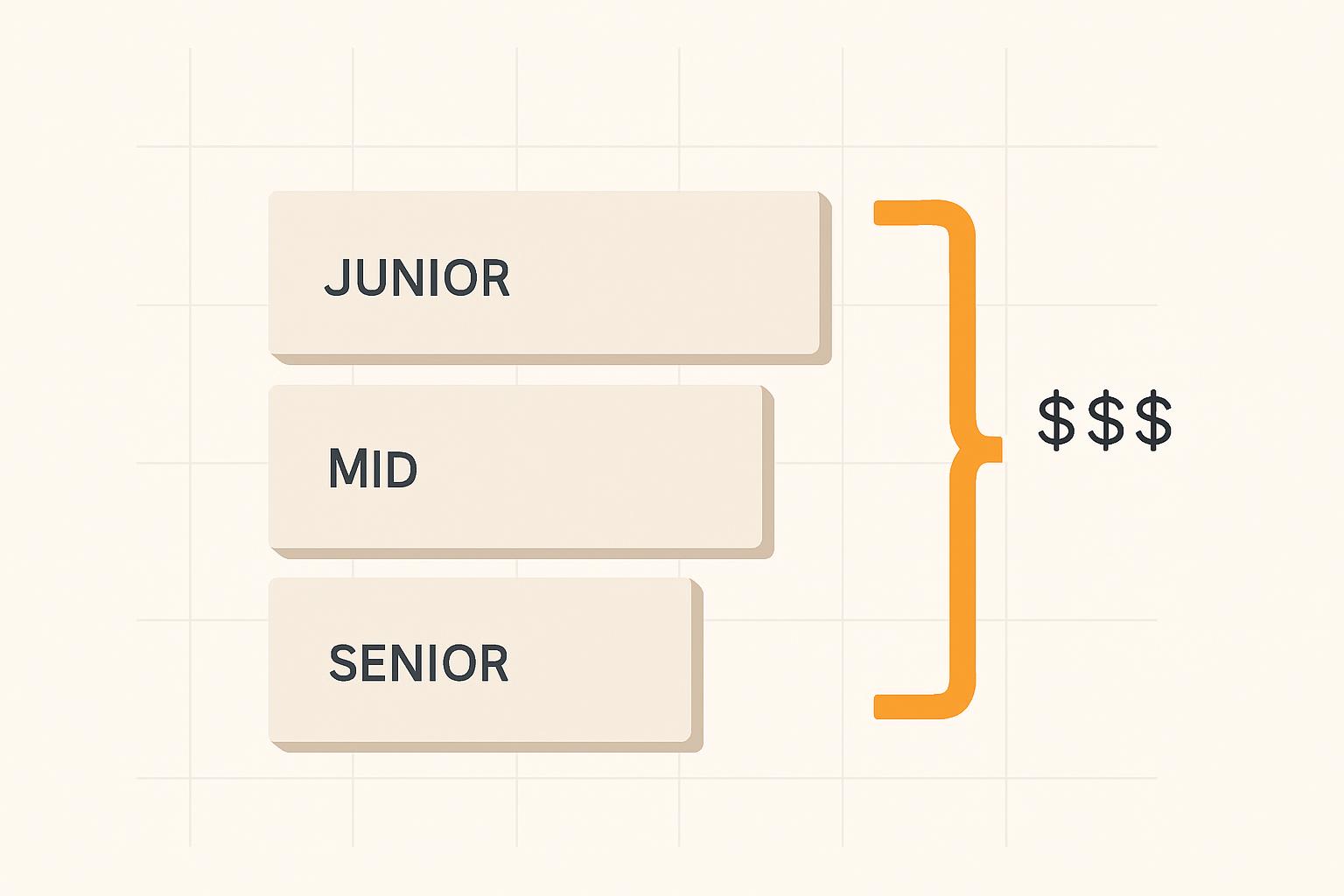
Traditional agencies scaled by adding implementers, more hands meant more billable hours. AI-native agencies scale differently. A senior engineer with strong model tooling can do the work that took three mid-level developers, which means leverage comes from seniority and tooling, not headcount. The org chart is flatter, more expensive per head, and more productive per dollar.
That changes what you hire for. You want people who can frame a problem, choose the right model and pattern, and ship, not specialists who only execute a narrow slice. The junior tier shrinks; the senior generalist tier grows. It also changes how you think about cost: a team of six expensive seniors can be more profitable than a team of fifteen mixed-seniority implementers, because revenue-per-head is higher and coordination overhead is lower.
The core roles
Scroll to see more
| Role | When to hire | US base | EU base | Billable? |
|---|---|---|---|---|
| AI / ML engineer | First (after founders) | $150K–$230K | €75K–€130K | Yes |
| Delivery lead / PM | 2nd–3rd | $110K–$160K | €60K–€95K | Partly |
| Product designer (AI UX) | 3rd–4th | $100K–$150K | €55K–€90K | Yes |
| Full-stack engineer | 4th–5th | $120K–$180K | €60K–€105K | Yes |
| Solutions / sales engineer | 5th–6th | $120K–$170K + var. | €65K–€110K + var. | No |
| Eval / QA specialist | 6th+ | $100K–$150K | €55K–€90K | Partly |
Brackets are 2024–2025 market ranges for established agencies; add 15–30% in SF/NYC and top-tier EU hubs, subtract for smaller markets and remote-first comp bands.
AI / ML engineer
Your first and most important hire. Look for someone who has shipped production AI, not just notebooks, and who is comfortable across the stack: prompts, retrieval, evals, and integration. This person sets your technical standard. Over-index on judgment and breadth here; a narrow specialist who can only fine-tune models is far less useful to a small agency than a generalist who can take a vague client problem and ship a working system.
Delivery lead / project manager
The hire founders delay too long. Once you're running 3+ concurrent engagements, ungoverned delivery becomes your bottleneck and your margin leak. A delivery lead protects scope, runs the client relationship, and keeps utilization healthy, they pay for themselves by preventing overruns. The signal you've waited too long: the founders are spending evenings on status updates instead of strategy.
Product designer (AI UX)
AI products live or die on interaction design, how you handle latency, uncertainty, errors and trust. A designer who understands AI UX patterns is billable and differentiating, especially for client-facing products. This is an underrated early hire; many agencies treat design as cosmetic and ship technically impressive systems that users don't trust.
Full-stack engineer
Your second engineering hire broadens capacity and de-risks the bus factor. Hire when your lead engineer is consistently the constraint and you have 2+ months of backlog. This is also where you can hire slightly more junior, a strong full-stack generalist with AI tooling ramps fast under a senior lead.
Solutions / sales engineer
The first dedicated non-billable revenue role. Hire when the founder's selling time is the cap on growth. Comp is base plus variable tied to closed revenue. A good solutions engineer shortens your sales cycle by translating vague client wants into scoped, credible proposals, which directly improves both win rate and pricing.
Eval / QA specialist
As builds get more serious, evaluation becomes a discipline, not an afterthought. This role owns test suites, regression checks and model-upgrade safety. In a mature AI-native agency, evaluation is a billable specialty in its own right, clients pay for the confidence that a model upgrade won't silently break production.
The hire-trigger math
Don't hire on vibes. Hire on two numbers: pipeline coverage and the revenue-to-cost ratio.
For a billable role, the fully-loaded cost (salary + benefits + overhead, typically 1.25–1.4× base) must be comfortably covered by the revenue that person can bill.
A billable hire should generate at least 3× their fully-loaded cost in revenue at target utilization. Below 3× you have no margin for ramp, bench time, or a slow quarter.
Worked example. A senior engineer at $190K base is ~$250K loaded. At a $185/hr bill rate and 65% utilization across ~1,800 working hours:
- Billable hours: 1,800 × 0.65 = 1,170
- Revenue: 1,170 × $185 = ~$216,000
That's only 0.86× loaded cost, below break-even. Push utilization to 75% and the rate to $210:
- Billable hours: 1,350; Revenue: ~$283,500 → 1.13× cost.
To clear the 3× rule you need either a much higher effective rate (value/outcome pricing, not hourly) or this engineer leveraged across productized offers where their time is amortized. This is exactly why AI-native agencies push so hard on productization and value pricing, pure hourly math rarely clears the bar for senior talent.
Utilization targets by role
Scroll to see more
| Role | Healthy utilization | Notes |
|---|---|---|
| Engineer (IC) | 70–80% | Leave room for evals & learning |
| Delivery lead | 40–60% billable | Rest is unbillable coordination |
| Designer | 65–75% | |
| Founder (delivery) | < 50% as you scale | Falling number is the goal |
Pushing utilization above these bands looks good on a spreadsheet and quietly destroys the business, burned-out seniors leave, evals get skipped, and quality regressions cost you more in rework and reputation than the extra billed hours were worth.
Contractors vs. full-time
Early on, contractors let you flex capacity without fixed cost, useful for spiky pipeline and specialized skills (a security reviewer, a niche integration). But your core technical standard-setters should be full-time: they hold your patterns, your evals, and your client relationships. A good rule is to keep the roles that define how you build in-house and contract the roles that merely add hands for a specific project. As you mature, convert your best repeat contractors to full-time before a competitor does.
Equity and comp structure
For the first handful of hires, expect to offer some equity or profit-share to attract senior talent below big-tech cash. Typical early-employee equity at a bootstrapped agency runs 0.5–3% depending on seniority and timing, often structured as profit-share rather than formal shares for an agency that may never raise. Pair base salary toward the middle of the bracket with a clear bonus tied to either utilization-and-quality (for delivery roles) or closed revenue (for sales roles). Avoid bonuses tied to utilization alone, they incentivize people to look busy rather than to ship value.
Interviewing for AI roles
Resumes lie about AI experience more than almost any other skill right now, because the field is new and everyone has "used AI." Replace the take-home-essay interview with a working session: give the candidate a realistic, messy problem (ambiguous requirements, imperfect data) and watch how they frame it, choose an approach, and reason about evaluation. You're hiring for judgment under ambiguity, not for the ability to recite model names. Always include a real teammate in the session, culture and collaboration matter more in a small team than raw individual brilliance.
Watch for a few reliable red flags. Candidates who reach for the most complex solution before understanding the problem will overbuild on client time. Candidates who can't explain how they'd know their system works, who have no instinct for evaluation, will ship confident-looking systems that quietly fail in production. And candidates who talk only about models, never about users or business outcomes, tend to optimize the wrong thing. In a small agency, every hire shapes the culture disproportionately, so a brilliant engineer who can't collaborate is a net negative regardless of raw skill.
Onboarding and ramp
A senior hire at an AI-native agency should be contributing to billable work within two to three weeks, but full productivity takes longer, plan for a 6–10 week ramp before you count their capacity at target utilization in your pipeline math. Compress it deliberately: pair the new hire with a standard-setter on a real engagement rather than handing them a documentation backlog, give them a small but real deliverable in week one so they ship something that matters early, and make your prompt libraries, eval harnesses and delivery checklists genuinely usable rather than tribal knowledge. The agencies that ramp fastest are the ones that treated their internal tooling and playbooks as a product for their own team long before the new hire arrived.
Remote, onsite, or hybrid
AI-native agencies skew remote, and for good reason: the talent you want, senior generalists who can wield AI tooling, is globally distributed and rarely concentrated near your office. Remote also widens your compensation bands, letting you pay competitively in lower-cost markets while charging client-market rates. The trade-off is that culture, standard-setting and ramp are all harder over a wire. The agencies that make remote work invest deliberately in written standards, recorded working sessions, and a few high-bandwidth moments a year where the team is physically together. If you're under roughly eight people and still defining how you build, a hybrid or co-located core can set the culture faster; past that, a well-run remote model is usually the stronger economic choice.
Retention is cheaper than hiring
Every hiring conversation should be paired with a retention one, because replacing a senior is far more expensive than the salary delta that would have kept them. A departing standard-setter takes context, client relationships and tribal knowledge with them, and the replacement carries a 6–10 week ramp before they're back to full capacity. The levers that retain AI talent are rarely just cash: interesting problems, real ownership, time to learn against a fast-moving field, and a team they respect. Budget explicitly for learning, conference time, a tooling allowance, slack in the schedule to absorb new techniques, and treat it as a retention investment, not overhead. An agency that becomes the place senior AI talent wants to be spends far less on recruiting than one that treats people as interchangeable billable units.
Sequencing as you grow
- 2–4 people (founder-led): founders sell and deliver; first AI engineer hire.
- 5–8 people: add delivery lead and designer; founders shift toward sales and standards.
- 9–15 people: pod structure (engineer + designer + delivery lead per pod); add sales engineer and eval specialist.
- 15+: specialize pods by offer or vertical; introduce a head of delivery.
Resist hiring ahead of revenue. Each new billable head should be backed by at least 1.5× their capacity in qualified pipeline before the offer goes out. The one exception worth making is the delivery lead, hiring that role slightly ahead of need usually pays for itself by protecting the margin on the work you already have.
Hiring decisions on indie SaaS teams follow the same gravity even when the headcount is one. OperatorBook recently published a Catalan founder's diary on the second-headcount decision: the role was a part-time native-language support agent (8 hours/week, $19/hr) brought on two weeks after a regional locale launch, because customer-language support coverage was the constraint, not headline growth. It is a useful comparable for agencies setting the first non-billable operations bracket on a vertical-SaaS client account.
Sources
- Levels.fyi, "AI/ML Engineer Compensation Data" (2024–2025).
- Glassdoor & Honeypot, "EU Tech Salary Benchmarks" (2024).
- SPI Research, "Professional Services Maturity Benchmark: Utilization & Leverage" (2024).
- Bench Accounting, "Agency Utilization and Bill-Rate Norms" (2023).

Written by
Ravi IyerRavi Iyer writes about hiring, org design and talent economics for AI-native agencies. He has built and scaled delivery teams from 5 to 60 people across two studios.
Frequently asked questions
What's the first hire for an AI-native agency?
A senior AI/ML engineer who has shipped production systems, not just prototypes. They set your technical standard and carry the most billable leverage. Founders should keep selling and managing delivery until a delivery lead becomes the next bottleneck.
How do I know when a billable hire will pay for itself?
Use the 3× rule: at target utilization, the role should generate at least three times its fully-loaded cost (roughly 1.25–1.4× base salary) in revenue. If hourly math can't clear that for senior talent, it's a signal to move toward value or productized pricing.
Why do AI-native agencies hire fewer juniors?
Because leverage comes from senior generalists wielding AI tooling rather than from many junior implementers. A senior engineer with strong tooling often replaces the output of several mid-level developers, so the junior tier shrinks and the senior tier grows.
When should I make my first non-billable sales hire?
When the founder's selling time has become the cap on growth, typically around 5–8 people. A solutions or sales engineer on base-plus-variable lets founders step back from full-time selling without stalling the pipeline.